
End-to-end encryption (E2EE) is a term you hear a lot, but what does it actually mean for your security? At its core, E2EE creates a truly private communication channel. It scrambles your information the second it leaves your device and only unscrambles it when it reaches the intended recipient.
Only you and the person you're talking to have the keys to decipher the conversation.
Your Digital Privacy: The Power of End-to-End Encryption
Think of it this way: you’re sending a valuable gift in a special lockbox. You’re the only one with the key to lock it, and your friend is the only one with the key to open it. No one else—not the mail carrier, not a curious neighbor, not even the company that made the lockbox—can get inside. That’s precisely what end-to-end encryption does for your digital messages, files, and video calls.
From the moment you hit "send," your data is turned into an unreadable jumble of code. It stays that way as it travels across the internet, bouncing from server to server. It only becomes readable again once it arrives safely on your recipient's device. This airtight process means that even the service provider hosting the call can't access your information.
Encryption as an Added Feature, Not a Core Design
It's important to know that not all encryption is created equal. Many services only encrypt data "in transit" (while it's moving) or "at rest" (while it's stored on their servers). This is good, but it leaves a critical gap: your data can be exposed and read on the server itself. E2EE closes that security loophole by making the data inaccessible to anyone but you and your recipient.
This is why choosing a platform where security is built-in, not bolted on as encryption as an added feature, is so critical. A practical example is how some video conferencing tools hide full E2EE behind premium plans, often costing $15-$25 per user per month. In contrast, platforms designed with a security-first mindset can offer this as a standard feature, which is a massive value proposition.
"You cannot build an exception that works safely for some without exposing everyone to risk. That is why every respected cryptographer has warned against this idea for decades."
This gets to the heart of the matter. Real security doesn't have tiers. When E2EE is implemented correctly, it provides an uncompromising defense for every user.
For any professional who handles sensitive client or company data, getting a handle on these security concepts is non-negotiable. If you want a solid foundation in cybersecurity principles, including the different types of encryption, exploring resources for the CompTIA Security+ certification can be incredibly helpful. It gives you a framework for cutting through marketing claims and assessing a provider’s real security posture.
Ultimately, the value of E2EE isn't just about the technology—it's about giving you complete control and confidentiality. Platforms that offer E2EE as a standard often bundle it with other valuable features like included webinars or unlimited meeting times, delivering a truly powerful and secure communications suite without the hefty enterprise price tag.
How End-to-End Encryption Actually Works
To get a real handle on end-to-end encryption, you have to look under the hood at the tech making it all possible. The whole system is built on a brilliant concept called asymmetric cryptography, which gives every user a matched pair of digital keys: a public key and a private key.
The easiest way to think about it is like having a personal mailbox with a public slot for mail.
- Public Key: This is your mailbox slot. Anyone you want can have its location, and they can use it to drop an encrypted message inside. It's designed to be shared openly without risking your privacy.
- Private Key: This is the one and only physical key that opens your mailbox. You keep it safe, stored right on your device, and it’s the only thing that can unlock the messages sent to you.
So, when a colleague wants to send you a confidential report, their device grabs your public key and uses it to scramble the file. Once it’s locked with your public key, the data is completely unreadable to anyone else. It can only be unscrambled with its matching private key—the one that only you have. This process ensures that even if someone intercepted the file on its journey, all they’d see is a meaningless jumble of code.
This diagram shows you that flow in action—from a clear message to a scrambled one, and finally to its secure destination.
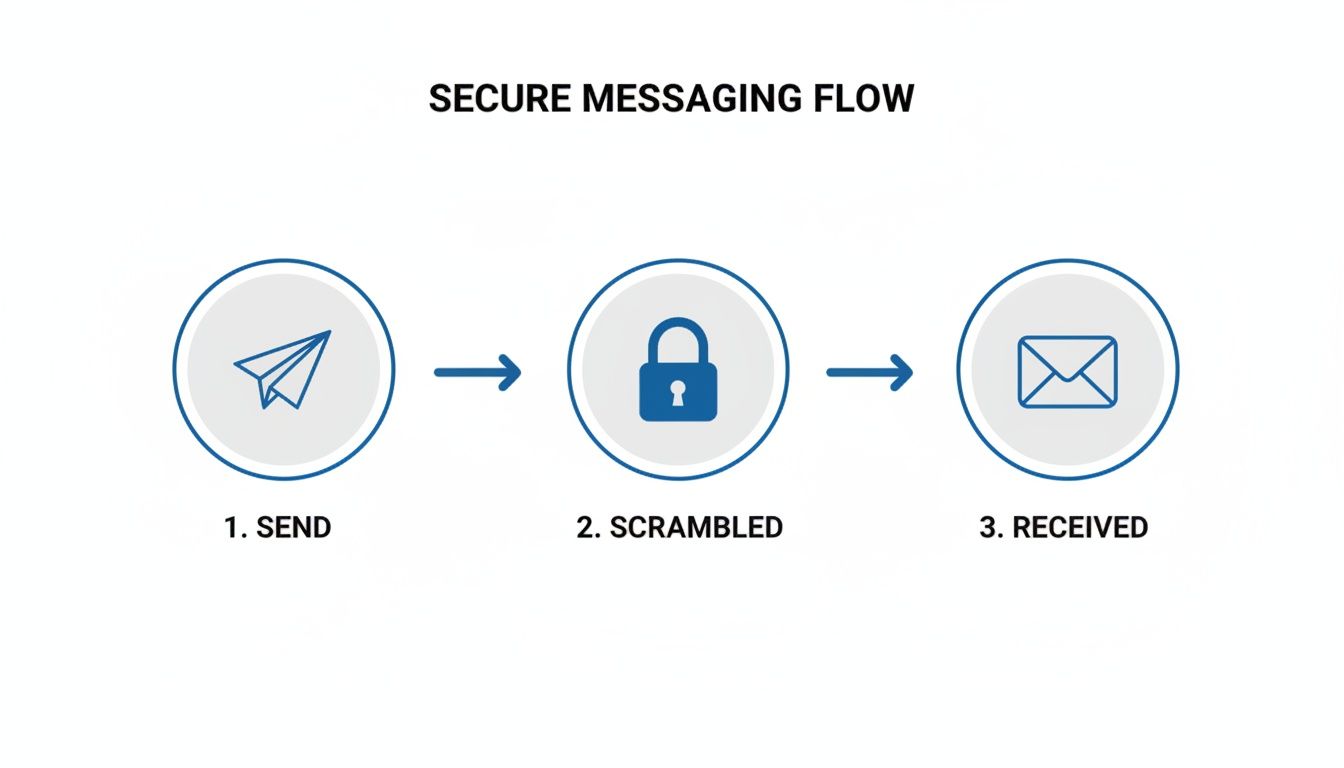
As you can see, the encryption happens on the sender's device before the message ever hits the internet. Decryption only happens once it's safely on the recipient's device.
The Power of Proven Cryptographic Standards
This public-private key system—often based on the RSA algorithm from 1977—is mainly used to securely exchange another type of key, called a symmetric key. This second key is the workhorse that actually scrambles the data itself using an incredibly tough algorithm like AES-256.
Combining both asymmetric and symmetric encryption is what gives modern E2EE its muscle. The strength of the encryption itself is everything. Old standards, like the Data Encryption Standard (DES) from 1977, used 56-bit keys. By the 1990s, a powerful computer could crack one in a few days. Today's E2EE relies on battle-tested standards like AES-256, an algorithm so trusted it was adopted by the U.S. government back in 2001.
The AES-256 standard uses a 256-bit key, which creates a mind-boggling number of possible combinations: around 1.1579 x 10^77. To put that in perspective, a supercomputer trying a trillion keys per second would still need billions of years to guess the right one. Brute-force attacks are simply not a realistic threat.
Practical Examples of Encryption in Action
This isn't just theory; it’s the technology protecting our conversations every single day. Here are some practical examples:
- Secure Messaging: When you send a message on an app like Signal or WhatsApp, your device uses your contact's public key to lock the message. Only their device, holding the private key, can unlock and read it.
- Video Conferencing: In a video call, E2EE wraps a secure layer around the audio, video, and anything else you share. A practical example is starting a meeting on a platform like AONMeetings, where the entire conversation—including any files or presentations you show—is kept completely private. You can learn more about this in our guide on how to share your screen.
- File Sharing: If you send a sensitive document, the file is scrambled on your device before it’s uploaded. It sits on the server as an encrypted block and only gets decrypted when your recipient downloads it using their private key.
Platforms offering E2EE as a core feature provide an excellent value proposition. For example, a secure meeting plan can cost as little as ₹179 per month. That's a huge difference compared to some enterprise plans that charge upwards of ₹1,500 per month for similar security. It makes real privacy accessible to everyone, not just giant corporations, often while bundling tools like included webinars.
E2EE vs. Other Encryption: What's Really Protecting Your Data?
When a service says your data is "encrypted," what does that actually mean? It's a common and risky assumption that all encryption is the same. The reality is quite different, and the distinctions are critical to understanding just how private your conversations are.
Let’s break down the three main types of encryption: encryption in transit, encryption at rest, and end-to-end encryption (E2EE).
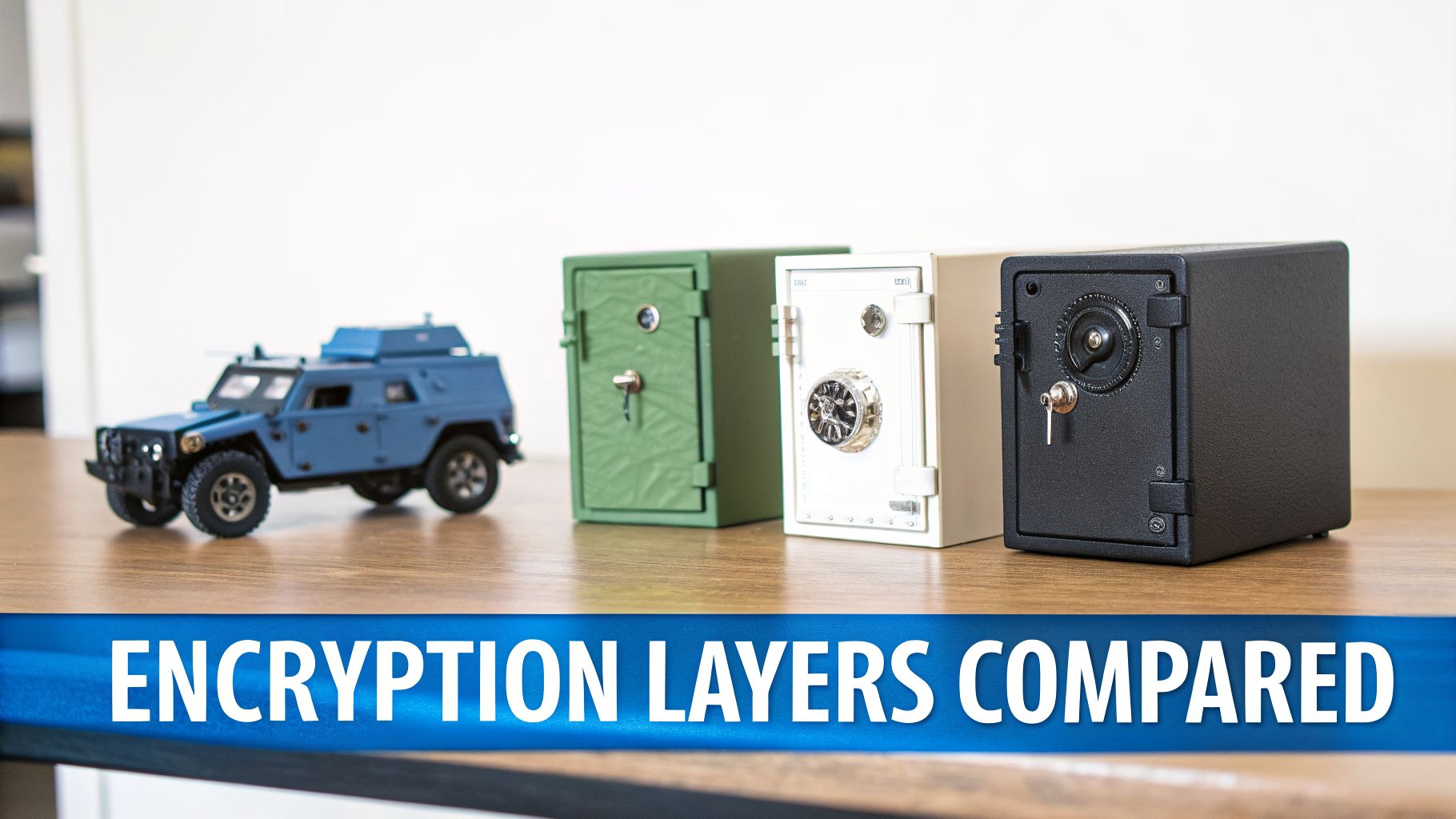
I find a simple analogy helps clear things up. Imagine you're sending a valuable package.
Encryption in Transit: This is like putting your package in an armored truck. It's safe while moving between your location and the destination bank, protected from anyone trying to hijack it on the road.
Encryption at Rest: This is the secure bank vault where the truck delivers your package. As long as it's locked inside, it's safe from thieves trying to break into the bank.
End-to-End Encryption (E2EE): This is different. Before the package even goes into the armored truck, you place it inside your own personal, unbreakable safe. Only you and your intended recipient have the keys to that safe. The armored truck can't open it, and the bank can't either. It remains locked from the moment it leaves your hands until the moment your recipient opens it.
The weak point in the first two methods is the hand-off. When the armored truck unloads at the bank, the bank staff (the service provider) can access the contents of your package. E2EE closes this security gap completely.
The Real Question: Who Can See Your Data?
Ultimately, it all comes down to one simple question: "Who holds the keys?" With only in-transit and at-rest encryption, the service provider always has a copy. This means they have the technical ability to access your data, whether it's for ad targeting, analytics, or responding to legal demands.
With true E2EE, the answer is simple: only you and the people you're communicating with. The provider's servers only see scrambled, unreadable data passing through. This distinction is fundamental to privacy. It's also why strong encryption is a cornerstone of meeting strict data security standards, like the HIPAA compliance IT requirements for healthcare.
"You cannot build an exception that works safely for some without exposing everyone to risk. That is why every respected cryptographer has warned against this idea for decades."
This quote gets to the heart of why E2EE is so important. As soon as you design a system that allows for special access—even with good intentions—you create a backdoor. That backdoor becomes a target for bad actors, fundamentally weakening the security for everyone.
Encryption Types Compared E2EE vs In Transit vs At Rest
To put it all together, here’s a straightforward comparison of what each type of encryption does and where its limits are. Understanding these differences helps you make informed choices about the tools you use.
| Feature | End-to-End Encryption (E2EE) | Encryption in Transit (TLS) | Encryption at Rest |
|---|---|---|---|
| Data Protection | Secures data continuously—on your device, in transit, and on the recipient's device. | Secures data only while it is actively moving between you and the server. | Secures data only when it is stored on a server or hard drive. |
| Who Can Access Data | Only the sender and intended recipient(s). The service provider has no access. | You and the service provider. The provider's servers can decrypt and read the data. | The service provider or anyone with access to the server’s decryption keys. |
| Primary Weakness | Compromised endpoints (e.g., malware on a user's device). | The provider’s servers, where data is decrypted and vulnerable. | The provider’s servers, if breached or if the encryption keys are compromised. |
| Best For | Private messaging, confidential video calls, and any situation where absolute privacy is essential. | Securing website connections (HTTPS) and stopping "man-in-the-middle" eavesdropping. | Protecting stored files, databases, and backups from theft or a server breach. |
As the table shows, only end-to-end encryption provides a complete, unbroken chain of privacy. When a platform is built around this principle, it's a powerful statement about its commitment to its users.
While some companies treat E2EE as encryption as an added feature, AONMeetings includes it as a standard feature, even on plans starting as low as ₹179 per month. This price comparison highlights its exceptional value proposition, making truly secure communication accessible to everyone. To learn more about how this applies in sensitive fields like healthcare, take a look at our guide to HIPAA-compliant video conferencing platforms.
From a Rebel's Tool to the Global Standard: The Story of E2EE
End-to-end encryption wasn't some corporate invention designed in a sterile boardroom. It was born out of a fight for digital privacy, a journey that took it from a niche tool for activists to the security backbone for billions of people. Understanding this history isn't just a trivia lesson—it shows why E2EE became a non-negotiable feature for any truly private conversation.
The story really kicks off in 1991 with a software developer and privacy advocate named Phil Zimmermann. He released a program called Pretty Good Privacy (PGP), a truly revolutionary tool that gave ordinary people the power to encrypt their own emails and files. For the first time, you didn't have to be a spy agency to guarantee your message could only be read by the person it was meant for.
This move immediately put Zimmermann on a collision course with the U.S. government.
The Crypto Wars and the Fight for PGP
Officials were terrified that widely available, strong cryptography could be a gift to criminals and terrorists, allowing them to operate in the dark. In a move that seems almost unbelievable today, the government classified PGP as "munitions" under export control laws. That's right—they treated software code like a weapon.
A criminal investigation was launched against Zimmermann in 1993 for simply making his code available online, an act they considered "exporting" a weapon. A practical example of the government's fear was their concern that foreign adversaries could use PGP to communicate without U.S. intelligence being able to eavesdrop.
The investigation dragged on for three years before being dropped in 1996, thanks in no small part to a massive public outcry and the simple fact that PGP had already spread across the globe. The genie was out of the bottle. Years later, the immense value of PGP was validated when Symantec acquired the rights to the technology for a staggering $300 million in 2010. You can dive deeper into this pivotal chapter by exploring the full story of PGP and its successors.
The Signal Protocol Changes Everything
While PGP proved people desperately wanted personal encryption, its design was built for the pace of email. As the world shifted to instant messaging, a new solution was needed. That breakthrough arrived in 2013 with TextSecure, the app that would evolve into the privacy-focused powerhouse we now know as Signal.
Signal introduced its namesake Signal Protocol, which brought two game-changing concepts to the table:
- Forward Secrecy: This brilliant feature ensures that even if someone steals your private key today, all of your past conversations remain secure. Each session generates a new, temporary key, so a single breach can't be used to retroactively decrypt your entire history.
- Asynchronous Messaging: It flawlessly secured instant messages, finally closing the gap between the speed of texting and the robust security of email encryption.
The Signal Protocol didn’t just improve encryption—it set a new, higher standard for what E2EE should be. It was so elegant and effective that it became the gold standard for securing conversations on some of the world's biggest platforms.
Today, this is the very same protocol that protects the daily communications of over 3 billion people on apps like WhatsApp, turning E2EE from a niche ideal into a global expectation. This battle-hardened technology is no longer just for journalists and activists; it's the security foundation for everything from confidential telehealth appointments to sensitive corporate strategy sessions on platforms like AONMeetings.
The best part? This level of security, once the subject of federal investigations, is now an expected feature, not a costly add-on. Many modern platforms even bundle this high-level privacy with valuable tools like included webinars, making powerful security accessible to everyone.
Where Security Meets Value: E2EE in Video Conferencing
The idea of end-to-end encryption isn't just for spies and secret agents anymore; it’s a cornerstone of modern video conferencing. As our meetings move online, understanding what is end-to-end encryption in this context has become absolutely critical. It’s the digital lock that separates a truly private discussion from a conversation that's accidentally left exposed.
When a video platform uses E2EE, it’s not just scrambling your video and audio. Think of it as creating a completely sealed, digital room for your meeting. Here are some practical examples of what's protected:
- Chat Messages: Your private sidebars and shared links stay between you and the other participants.
- Screen Sharing: Presentations with proprietary data or sensitive client information are completely shielded from outside eyes.
- File Transfers: Any documents you share are encrypted on your device and only decrypted when they reach their destination.
This level of comprehensive security is non-negotiable for anyone handling sensitive information. We're talking about everything from HIPAA-compliant telehealth sessions and confidential legal depositions to high-stakes corporate strategy meetings.
The Real-World Value Proposition of E2EE as a Core Feature
Here’s something many people don’t realize: implementing E2EE is a deliberate design choice. It signals that a company values your privacy more than it values harvesting your data. Because of the technical overhead, many platforms treat E2EE as encryption as an added feature, something you only get if you pay for their most expensive enterprise plans.
But some providers, including AONMeetings, take a different approach. They build their platform with E2EE at its core, making it a standard feature for everyone.
This flips the script on value. Instead of paying extra for the security you need, you get it as part of a package that already includes other powerful tools. This is an excellent value proposition: the intersection of security and practical business tools.
A platform that builds on a foundation of E2EE often bundles it with other high-value features, like included webinars or unlimited meeting times. This creates a complete communication toolkit, so you never have to choose between your budget and your security.
Imagine getting the peace of mind that comes with bank-level encryption while also having the freedom to run a two-hour training webinar without watching the clock. That’s a model designed to empower businesses, not just bill them for essentials. To see how this plays out for different use cases, take a look at our guide on the best video conferencing for small business.
Price Comparisons: How Security Affects Your Bottom Line
The cost for E2EE can vary dramatically from one platform to another. Many of the big names reserve their strongest security for top-tier plans, which effectively creates a "security gap" between businesses that can afford it and those that can't.
Let's break down the real-world cost difference with a price comparison:
| Platform | E2EE Availability | Typical Monthly Price Per User (for E2EE) |
|---|---|---|
| Zoom | Available, but often requires manual activation in settings. | $20+ (Included in Business and Enterprise plans) |
| Microsoft Teams | E2EE for 1-on-1 calls; meeting E2EE has limitations. | $12.50+ (Part of Microsoft 365 Business Standard) |
| AONMeetings | Included by default on all plans. | Starts at ₹179 (approx. $2.15) |
As you can see, the difference is stark. AONMeetings makes enterprise-grade E2EE an accessible, standard feature. This puts top-tier security within reach of the small businesses, healthcare clinics, and solo consultants who often need it the most.
The Firm Stance on Encryption "Backdoors"
The debate over unbreakable encryption came to a head in a major national security incident. The 2015 San Bernardino shooting became a flashpoint when the FBI demanded that Apple create a "backdoor" to unlock an attacker's iPhone. Because the device used default E2EE in iOS 9, not even Apple could access its contents without the passcode.
Apple's CEO, Tim Cook, publicly refused. He argued that building a special key for one case would create a massive vulnerability that could be exploited by anyone, putting the privacy of millions at risk. This public conflict highlighted the power of true E2EE, a technology that already protected the messages of 900 million WhatsApp users at the time. The message for modern businesses is clear: security can't be selective. You can read more about the history of E2EE on Wikipedia.
This is precisely why uncompromising E2EE is so vital in sectors like healthcare. A practical example: between 2009 and 2021, over 2,200 data breaches exposed the records of 500 million patients. For a telemedicine practice, using a platform with unyielding encryption isn't just encryption as an added feature—it’s a fundamental requirement for building patient trust and ensuring HIPAA compliance.
Common Questions About End-to-End Encryption
Okay, so we've covered the "what" and "how" of end-to-end encryption. But that usually leads to some very practical, real-world questions. It's one thing to understand the theory, but another to know what it means for the apps you use every day.
Let's tackle a few of the most common ones that come up.
How Can I Tell If My App Truly Uses End-to-End Encryption?
Start with the source. Any company that goes through the trouble of building proper E2EE is going to be proud of it. Dive into their security page or privacy policy—if they’re cagey or vague about their encryption methods, that's a major red flag.
Beyond the marketing, look for in-app verification tools. A practical example is the "safety number" or QR code you see in secure messaging apps. This feature lets you and your contact compare a unique code to confirm that no one is intercepting your conversation. It’s a tangible way to verify the private channel between your devices.
Are There Downsides to Using End-to-End Encryption?
There are always trade-offs, and with E2EE, the main one is usually functionality. Because the service provider has zero access to your content, it can make certain features tricky to implement. For instance, a global search of your entire chat history across multiple devices is often limited, since that data isn't sitting on a server for them to index.
Data recovery is another consideration. If you lose your device and don't have a recovery key, your encrypted data could be gone for good. This is a core security feature—not a flaw—but it’s something you have to be mindful of.
Keep in mind that E2EE protects the content of your messages, not the metadata. Your service provider can often still see who you are communicating with and when, even if they can't read the messages themselves.
Why Don't All Services Use E2EE If It's So Secure?
It really boils down to two things: their business model and the sheer technical difficulty. Many "free" services aren't really free; they make money by scanning your data to sell targeted ads. That entire business model falls apart when your data is end-to-end encrypted.
On top of that, implementing and maintaining E2EE is genuinely hard, especially for complex scenarios like group video calls or keeping messages synced across all your devices. This is why many platforms treat it as encryption as an added feature. A clear price comparison shows this: many lock E2EE behind plans that cost $20 or more per user per month. A strong value proposition is finding a platform that includes true E2EE as a standard feature, alongside useful tools like included webinars, as this is a huge win for both security and your budget.
At AONMeetings, we believe enterprise-grade security shouldn't come at an enterprise price. That's why we include end-to-end encryption on all plans, so you can host secure, unlimited meetings with confidence. Start protecting your conversations today at https://india.aonmeetings.com.
