
You're back from a conference with a badge in your bag, a notebook full of half-legible notes, and a contacts list that already feels colder than it did on the expo floor. That's the moment most opportunities are lost. Not at the booth. Not during the panel. In the quiet day after, when people mean to follow up and then send nothing, or worse, send a generic “great meeting you” email that gives the other person no reason to reply.
A good follow up email after a conference does one job well. It turns a brief interaction into the next concrete step. That might be a call, a demo, a candidate screen, a sponsor discussion, or a referral. If the email doesn't make that next move easy, it usually dies in the inbox.
Why Your Follow-Up Matters More Than Ever
The usual post-conference pattern is predictable. Sales teams export leads. Recruiters sort resumes. founders promise to “circle back next week.” Then everyone opens their inbox and starts triaging. The contacts who get remembered are rarely the ones who had the longest conversation. They're the ones who send the clearest, most relevant note while the interaction still feels current.
That's why I treat the follow-up as part of the conference itself, not as admin work after the fact. If you talked with a hospital operations lead about telehealth workflows, a university program director about online teaching, or a startup founder about partnerships, the conversation is only half-finished until one person sends the bridge to the next action.
What weak follow-ups do
Most bad conference emails fail in one of three ways:
- They're too vague. “Great meeting you at the event” doesn't remind anyone what you discussed.
- They ask for too much. A long recap, three attachments, and a calendar request can feel like work.
- They sound mass-produced. If the message could have gone to fifty people, the recipient knows it.
A healthcare example makes the point. If you met a clinic administrator and your first email summarizes sensitive patient scenarios or internal workflow details, you've already made the conversation riskier than it needs to be. If you met a recruiter and your note says only “let's stay in touch,” you've created no decision path at all.
Practical rule: The best conference follow-up isn't the longest email. It's the one that helps the recipient remember you fast and respond with minimal effort.
The etiquette changed
Older networking advice often treated follow-up as a courtesy. That mindset doesn't hold up anymore. People move fast, and inboxes are crowded. A relevant note sent quickly now does more than signal professionalism. It preserves context before the recipient mentally files you away with every other person they met that week.
If your next step is a virtual call, strong virtual meeting best practices matter too, because the handoff from email to meeting should feel simple, not like another scheduling obstacle.
The contacts you want to keep won't object to a thoughtful email. They'll appreciate that you made it easy to continue a useful conversation.
The Perfect Timing and Subject Line Strategy
Timing decides whether your message lands as a welcome reminder or as one more forgotten follow-up. The standard that holds up best is simple: send the first note within 24 to 48 hours. Guidance collected by Kixie on conference follow-up timing says outreach within 24 hours can improve response rates, and it cites attendee behavior showing that more than 22% care about making a strong first impression while nearly half want outreach while the interaction is still fresh.
That doesn't mean every contact needs the exact same speed. A buyer who asked for pricing deserves a same-day or next-day response. A recruiter who met a candidate between sessions can send a lighter note first, then a more detailed second touch once the event dust settles. The point is to move while memory is intact.
Use a subject line that sounds like a real conversation
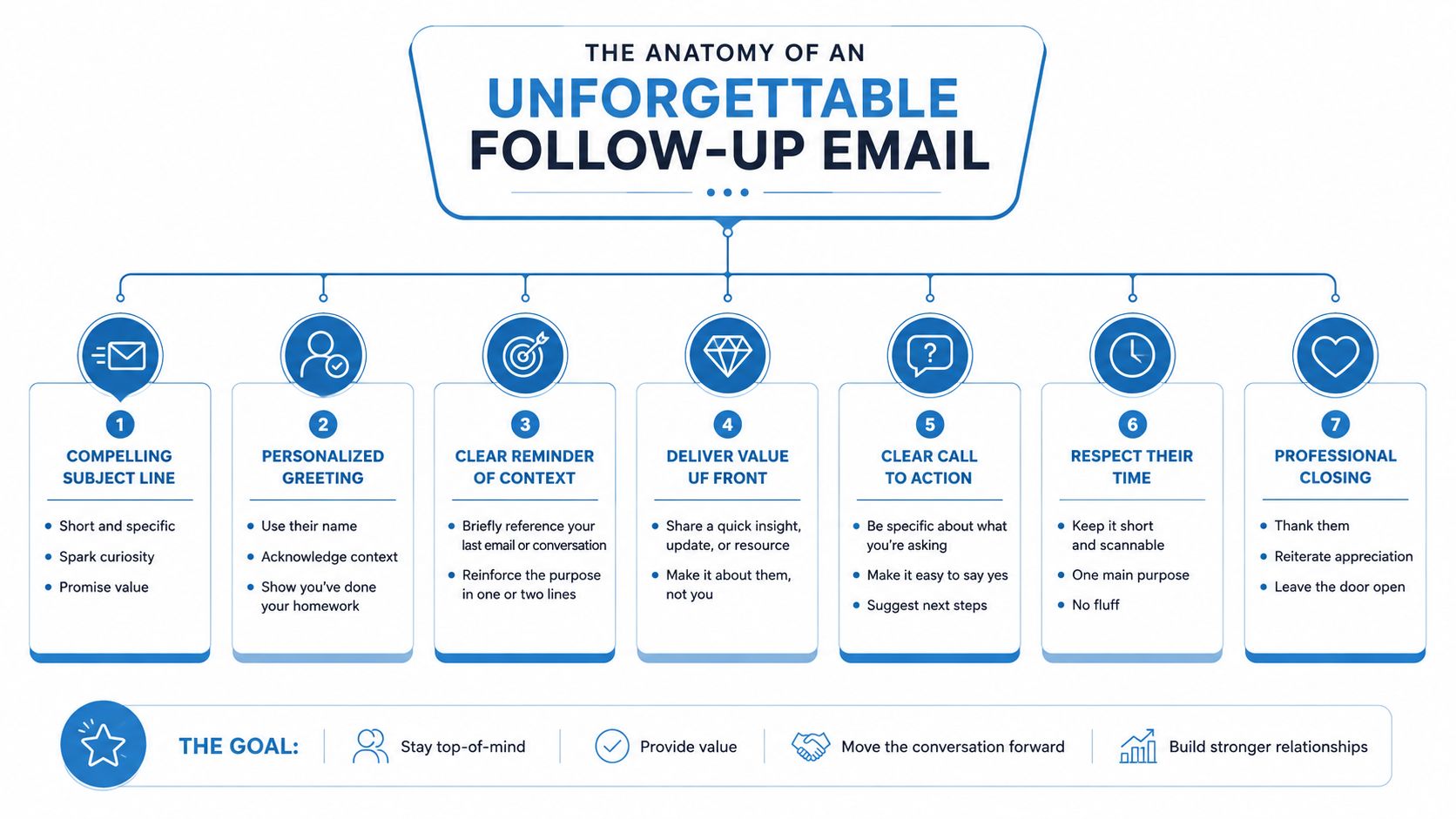
The strongest subject lines do three things:
- Reference the event or context
- Add one personal detail
- Point to value or the next step
That formula beats generic lines almost every time.
Weak options:
- Great meeting you
- Following up
- Touching base after the conference
Better options:
- Enjoyed our chat at HIMSS about patient intake workflows
- Quick follow-up from the recruiting panel in Bengaluru
- Your question on webinar attendance from yesterday's event
- Next step after our conversation on campus partnerships
If you want a broader set of examples, this collection of effective follow-up subject lines is useful because it shows how specificity changes the tone immediately.
Match the subject line to the relationship
A subject line should sound like the meeting you had.
| Scenario | Weak subject line | Better subject line |
|---|---|---|
| Healthcare operations | Nice meeting you | Follow-up on secure telehealth scheduling discussion |
| Recruiting | Job fair follow-up | Great meeting you at the engineering careers event |
| Startup partnership | Checking in | Next step from our partner booth conversation |
| Education | Following up after conference | Loved your idea on online student support |
People open conference follow-ups when the email sounds like it belongs to one exact interaction, not to a mailing list.
Don't confuse speed with pressure
Fast is good. Rushed is not. If you send a message within a day but make the recipient process a wall of text, attach multiple documents, and choose from five possible next steps, you've undone the advantage of timing. Keep the email short enough to scan on a phone. Ask for one thing. Give the person an easy way to say yes.
That balance is what separates an effective follow up email after a conference from an eager but forgettable one.
Anatomy of an Unforgettable Follow-Up Email
A good conference follow-up email does one job. It helps the recipient remember the conversation and makes the next step easy to accept.
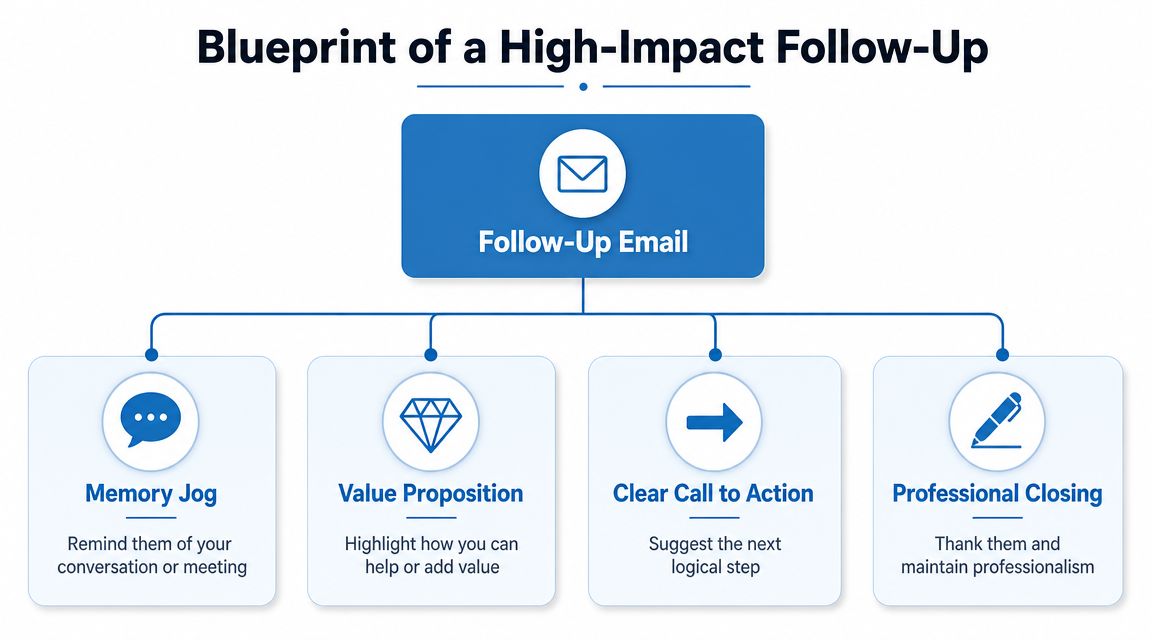
After years of sending these, I've found the strongest emails are built from four parts. They restore context fast, show a reason to keep talking, ask for one clear action, and close cleanly. That holds up whether you met a hospital operations leader, a recruiting manager hiring at volume, or a founder testing partnerships.
Start with the memory jog
The opening line should answer one question immediately: why should they remember you?
Use a specific detail from the interaction:
“Good meeting you after the digital learning panel. I was the one asking about attendance reporting and parent communication.”
That works because it points to a moment, not just an event. At crowded conferences, people rarely remember your name first. They remember the panel, the booth conversation, the question they answered, or the problem they were trying to solve.
If you work in a regulated industry, keep that memory jog specific without getting careless. In healthcare, for example, refer to the workflow or operational issue you discussed, not patient details. In financial services, mention the compliance topic or team challenge, not account information.
Add the value bridge
The second part should answer a harder question: why should they reply?
A value bridge connects your note to something useful from the conversation. Usually that means one of four things:
- the resource you said you would send
- the business problem they mentioned
- a relevant idea tied to their current priority
- a practical reason for a short next conversation
Here's the trade-off. If the value section is too vague, the email feels generic. If it is too detailed, it starts reading like a pitch deck pasted into an inbox.
A recruiter follow-up might say:
“You mentioned your team needs to fill 20 support roles before the next intake cycle. I can share the screening workflow we've seen reduce recruiter back-and-forth in high-volume hiring.”
A healthcare follow-up might say:
“You mentioned intake delays between referral and appointment scheduling. I can outline the handoff points other clinic teams review first before changing staff workload.”
Both examples stay grounded in the conversation. Both avoid oversharing. That matters more in industries where privacy, approval chains, or legal review slow down the next step.
Make the ask smaller than the eventual goal
Good emails usually win or lose here.
If you just met someone at a conference, asking for a full demo, partnership review, or internal introduction can be too much. A smaller ask gets more replies because it matches the level of trust you earned in person.
Useful calls to action include:
- “Would a 15-minute call next week be useful?”
- “If helpful, I can send a one-page summary first.”
- “Should I send two time options for a quick follow-up?”
- “Would it make sense to include your operations lead on the next conversation?”
The best CTA gives them one decision to make. It also sets up the systems you'll use later, whether that means dropping the contact into your CRM, sending a scheduling link, or logging the promised resource so the follow-up does not stall.
Close with professionalism
The close should be short and steady. Thank them for the conversation, restate the next action, and sign with enough context that they know who you are.
A clean structure looks like this:
- Memory jog tied to the exact interaction
- Value bridge linked to their stated problem or goal
- Single CTA that asks for one small next step
- Professional sign-off with your name, role, and company
That format works because it respects the recipient's time. It also gives you a repeatable process you can adapt by industry. A university partnerships follow-up will sound different from a healthcare operations note, and both should sound different from a recruiting message sent after a career fair. The structure stays the same. The language changes to fit the stakes, pace, and compliance requirements of the conversation.
Tailored Templates for Every Industry
Generic templates break down fast in practice. A recruiter doesn't write like a healthcare administrator. A university director doesn't reply to the same framing as a startup founder. The best follow up email after a conference sounds like it belongs to that industry's pace, risk level, and decision style.
For regulated sectors, restraint matters even more. Guidance on conference follow-up in privacy-sensitive settings emphasizes that what you leave out matters. In regulated industries like healthcare or finance, best practice is to avoid sensitive personal data or internal pricing in the initial email and move detailed discussion to a secure, encrypted channel or a scheduled call, as explained in this guidance on safe conference follow-up.
Healthcare provider template
You met a clinic director at a digital health event. You discussed intake bottlenecks and patient communication.
Subject: Good meeting you at the healthcare conference on intake workflows
Hi [Name],
It was good speaking with you after the session on clinic operations. I appreciated your perspective on reducing intake friction without adding more admin load to your staff.
You mentioned that your team is reviewing how patients move from first contact to confirmed appointment. I think there's a useful follow-up conversation there, especially around communication flow and handoff points.
Rather than put operational details into email, I'd be glad to continue the discussion on a secure, encrypted call if that's helpful. If you'd prefer, I can also send a short outline of the workflow areas we discussed.
Best,
[Your Name]
Education template
You met a school leader or coaching center owner looking at online delivery and student engagement.
Subject: Enjoyed our conversation on student engagement at [Event Name]
Hi [Name],
I enjoyed talking with you about how your team handles online classes and follow-up with students after live sessions.
Your point about keeping classes interactive while still making recordings useful stood out to me. That's usually where delivery decisions either support teaching quality or create more work for faculty.
If it's useful, I'd be happy to compare notes on virtual classroom setup, webinar-style sessions for parent outreach, or a simple scheduling workflow for staff and students.
Regards,
[Your Name]
Startup partnership template
You met a founder exploring integrations, co-marketing, or channel partnerships.
Subject: Next step from our startup partnership conversation
Hi [Name],
Great meeting you at [Event Name]. I liked your take on where your product fits and where partnerships could shorten the path to adoption.
Based on our conversation, I see two realistic areas to explore: a joint webinar for audience overlap, or a smaller intro call to see whether our teams are aligned before either side commits more time.
If you're open to it, send me the better option and I'll keep the next step focused.
Thanks,
[Your Name]
Event marketer template
You met a sponsor, speaker, or events lead who cares about lead quality after the event, not just booth traffic.
Subject: Good discussion on sponsor follow-up and event conversion
Hi [Name],
It was good connecting at [Event Name]. Your comment about the gap between lead capture and actual post-event meetings was exactly right.
A lot of teams collect contacts well and then lose momentum because the follow-up doesn't point to one next action. In your case, I think a short sponsor recap or webinar invitation tied to the topic you mentioned could work better than a broad “thanks for visiting” message.
If you want, I can send a sample sequence specifically designed for sponsors or speakers.
Best,
[Your Name]
Recruiter template
You met a candidate at a career fair or hiring conference. The key is speed, relevance, and a low-friction next move.
Subject: Great meeting you at the recruiting event
Hi [Name],
It was good meeting you at [Event Name]. I enjoyed hearing about your background in [field/role], especially your experience with [specific point discussed].
You mentioned you're open to roles that offer [specific preference]. Based on that, I think there could be a fit worth discussing further.
If you're interested, reply with your updated resume or a few times for a short conversation this week. I'm happy to keep the first discussion practical and focused on role fit.
Best,
[Your Name]
A few industry adjustments that matter
- Healthcare and finance: Keep the first email minimal. No sensitive records, no internal pricing, no long recap thread. Move detail to a secure, encrypted channel.
- Education: Lead with outcomes, logistics, and ease of adoption. Faculty and administrators often care about implementation friction as much as features.
- Recruiting: Use speed, but don't send a form-letter blast. Candidates can spot automation immediately.
- Partnerships and startups: Give two plausible next-step paths, not six.
- Event marketing: Tie the follow-up to post-event content, especially webinars, speaker clips, or sponsor value, not just a generic thank-you.
The right template doesn't feel templated. It feels like you remembered the conversation and respected the recipient's context.
Advanced Follow-Up Strategies and Tooling
You leave the conference with 40 contacts, 12 decent conversations, and maybe 3 real opportunities. By Friday, those names start to blur unless your process does the remembering for you.
That is the difference between casual follow-up and a repeatable system. Good conference follow-up is not just email copy. It is timing, prioritization, tracking, and a clean handoff into the next action.
Build a sequence around intent
A single follow-up works for people who were already ready to buy, hire, partner, or schedule. Everyone else needs a sequence, but each message has to earn its place. If email two and email three only ask, “Just following up,” you are training the recipient to ignore you.
A practical sequence usually looks like this:
- Touch 1: Send the personal follow-up while the conversation is still fresh. Confirm context and propose one next step.
- Touch 2: Add the promised asset. That might be a case study for a hospital operations leader, a sample implementation plan for an education buyer, or two open roles for a candidate you met at a hiring event.
- Touch 3: Narrow the decision. Ask for a 15-minute call, suggest the right internal stakeholder, or confirm whether timing is the blocker.
- Touch 4: Close the loop politely. Give them a clear way to re-engage later.
I use different sequences for different industries because the stakes are different. In healthcare, a second email might offer a short call with compliance or procurement copied in later, not a long product explainer. In recruiting, the second touch often works better as a calendar link plus two role options, because candidate interest drops fast. In software partnerships, the third touch can be a one-page partner outline, since vague “let's collaborate” emails rarely go anywhere.
Track signals that show real interest
Replies matter, but they are not the only useful signal. Opens, clicks on your scheduling link, webinar registrations, forwarded emails, and repeat visits to a shared resource all tell you whether the conversation still has life.
That is where a CRM earns its keep. A simple setup is enough if it helps you answer four questions quickly:
- Who did we meet?
- What did they care about?
- What was the promised next action?
- When do we follow up again?
Sales teams usually track pipeline stage. Recruiters often track role fit, availability, and application status. Event marketers care more about content engagement and meeting conversions. The tool can vary. The discipline cannot.
Make the next step easy to book
A lot of conference follow-up breaks at the handoff. The email is fine. The scheduling is clumsy.
If your goal is a webinar, demo, candidate screen, or partner call, remove friction immediately. Use a booking link with limited choices. Offer a secure channel when the conversation touches regulated information. If webinars are part of your post-event flow, this guide on how to increase webinar attendance is a useful reference for reminders, topic framing, and registration flow.
Lead capture quality also shapes follow-up quality. If your team is still working from business cards and half-written notes, your emails will sound generic because the source data is generic. Darkaa's lead capture QR is worth considering for trade shows and expos because it shortens the gap between booth conversation and usable contact data.
Choose meeting tools based on the follow-up motion
The right meeting platform depends on what happens after the email. A recruiter may only need fast candidate screens. A healthcare team may need encryption and tighter control over access. An event marketer may care about webinars, registration, and recordings.
Here is a practical way to compare the next-step tools teams often evaluate after a conference conversation:
| Feature | AONMeetings | Zoom (Pro) | Microsoft Teams (Essentials) |
|---|---|---|---|
| Starting price | ₹179 per user per month | Business meeting platform with plan-based pricing | Business collaboration platform with bundle-based pricing |
| Unlimited meeting time | Included | Depends on plan details | Depends on plan details |
| Webinars included | Included in all plans | Often tied to separate webinar options or add-ons | Depends on plan and event format |
| Encryption | Bank-level encryption | Encryption available | Encryption available |
| Browser-based join | Yes | Available in many workflows | Available in many workflows |
| Hidden fees or contracts | No contracts, no hidden fees | Varies by plan and add-ons | Varies by plan and bundle |
| Extras mentioned by publisher | Screen sharing, whiteboards, document sharing, recordings, breakout rooms on advanced tiers, live streaming, multi-camera broadcast | Varies by plan | Varies by plan |
The trade-off is straightforward. Teams that run regulated conversations often care more about security and access control than flashy meeting features. Recruiting teams usually care more about speed and low booking friction. Event teams care about whether a follow-up can turn into a webinar or group session without adding another tool to the stack.
The follow-up email gets the reply. The system behind it gets the meeting.
Turning Conference Connections into Relationships
The point of a follow up email after a conference isn't to check a box. It's to create continuity. That's why the best messages feel less like outreach and more like good professional memory. They remind the other person where you met, why the conversation mattered, and what should happen next.
Cadence matters as much as content. Guidance on post-meeting follow-up has captured the essential challenge well: it's not only about speed, but about what sequence preserves recognition without causing fatigue. For large events, a short same-day thank-you followed by a second, value-add message 3 to 7 days later is often more effective than repeating the same reminder, as noted in Dropbox's guidance on follow-up cadence.
Think beyond the email itself
The strongest conference operators make follow-up easier before the event even ends. They take brief notes right after conversations. They tag contacts by priority. They know whether the next step is a meeting, a webinar, a candidate screen, or a secure call.
Lead capture also affects follow-up quality. If your team is still sorting handwritten cards and vague notes, your emails will sound vague too. Tools like Darkaa's lead capture QR are worth a look because they tighten the handoff from booth conversation to actual outreach.
Relationships compound when the next step is easy
A contact doesn't become valuable because they replied once. The value comes from repeated, relevant interactions. A sponsor becomes a recurring partner. A candidate becomes a hire. A clinician becomes a referral source. A founder becomes a channel relationship. That only happens when each follow-up respects timing, context, and attention.
If webinars are part of your relationship-building playbook, it helps to know how to host a webinar well enough that the invitation feels like a real opportunity, not just another marketing send.
Send the first email while they remember you. Make the message specific. Give them one easy next move. Then keep proving, through your cadence and content, that the conversation was worth continuing.
If you need a secure, low-friction way to turn conference follow-ups into meetings or webinars, AONMeetings is built for that handoff. It offers HIPAA-compliant video meetings, built-in webinars, bank-level encryption, unlimited meeting time, and browser-based joining starting from ₹179 per user per month, with no contracts or hidden fees. For healthcare teams, educators, recruiters, and event marketers who want a practical next step after the email, it's a strong fit.
