
You sent the contract after a video call. The client clicked Sign. Everyone moved on as if the deal were done.
That's how most business gets handled now. The operational question is easy. The legal question is harder. Not because electronic signatures are some fringe concept, but because the legality of electronic signatures usually turns on the process around the signature, not the on-screen mark itself.
In practice, the mistake isn't using e-signatures. The mistake is assuming a typed name, a checkbox, or a stylus scribble automatically gives you the same protection in every situation. It doesn't. Courts, auditors, regulators, and counterparties want to know who signed, what they signed, whether they meant to sign it, whether they agreed to do the transaction electronically, and whether you can still prove all of that later.
For a low-risk vendor acknowledgment, a basic flow may be enough. For a patient consent form, a cross-border commercial agreement, or a disputed employment contract, the details matter much more. That's where good compliance work earns its keep.
Are Your Digital Agreements Legally Binding
A business owner usually asks the question too late. The document has already been signed, a payment dispute has surfaced, or a regulated record needs to be produced. At that point, “is it legal?” becomes “can I prove it?”
In the United States, the ESIGN Act established a major baseline in 2000 by making electronic signatures legally valid and enforceable for most interstate and international commerce transactions, and by providing that a document can't be denied legal effect solely because it is electronic, as summarized in Adobe's overview of U.S. and EU electronic signature regulations. In the European Union, eIDAS created a separate framework with different signature levels and stronger formal treatment for the highest tier.
That broad legal recognition is real. It's also incomplete if you stop there.
A useful primer on ESIGN and eIDAS explained helps frame the difference between legal acceptance and legal defensibility. That distinction matters in practice because a challenged signature is an evidence problem before it becomes a legal theory problem.
What usually goes right
Most ordinary business contracts hold up fine when the signing flow is deliberate and well documented. A signer opens the document, reviews it, clicks a clearly labeled signing action, receives a copy, and the platform preserves the record.
If your team is already closing deals over video, the meeting itself can also support the record. That's one reason operational discipline matters during remote execution. Teams that rely on online negotiations should also tighten their meeting process with guidance like these virtual meeting best practices, because poor identity checks upstream often create signature disputes downstream.
What usually goes wrong
The weak spots are predictable:
- Unclear intent: A signer claims they were only viewing, not signing.
- No consent trail: The file is electronic, but there's no evidence the parties agreed to transact that way.
- Bad attribution: A shared inbox, forwarded link, or assistant-driven workflow makes identity murky.
- Missing records: The final signed version, timestamp history, or audit log can't be produced cleanly.
Practical rule: If your process would look flimsy when printed and handed to a judge, it's flimsy on-screen too.
Understanding the Different Types of Electronic Signatures
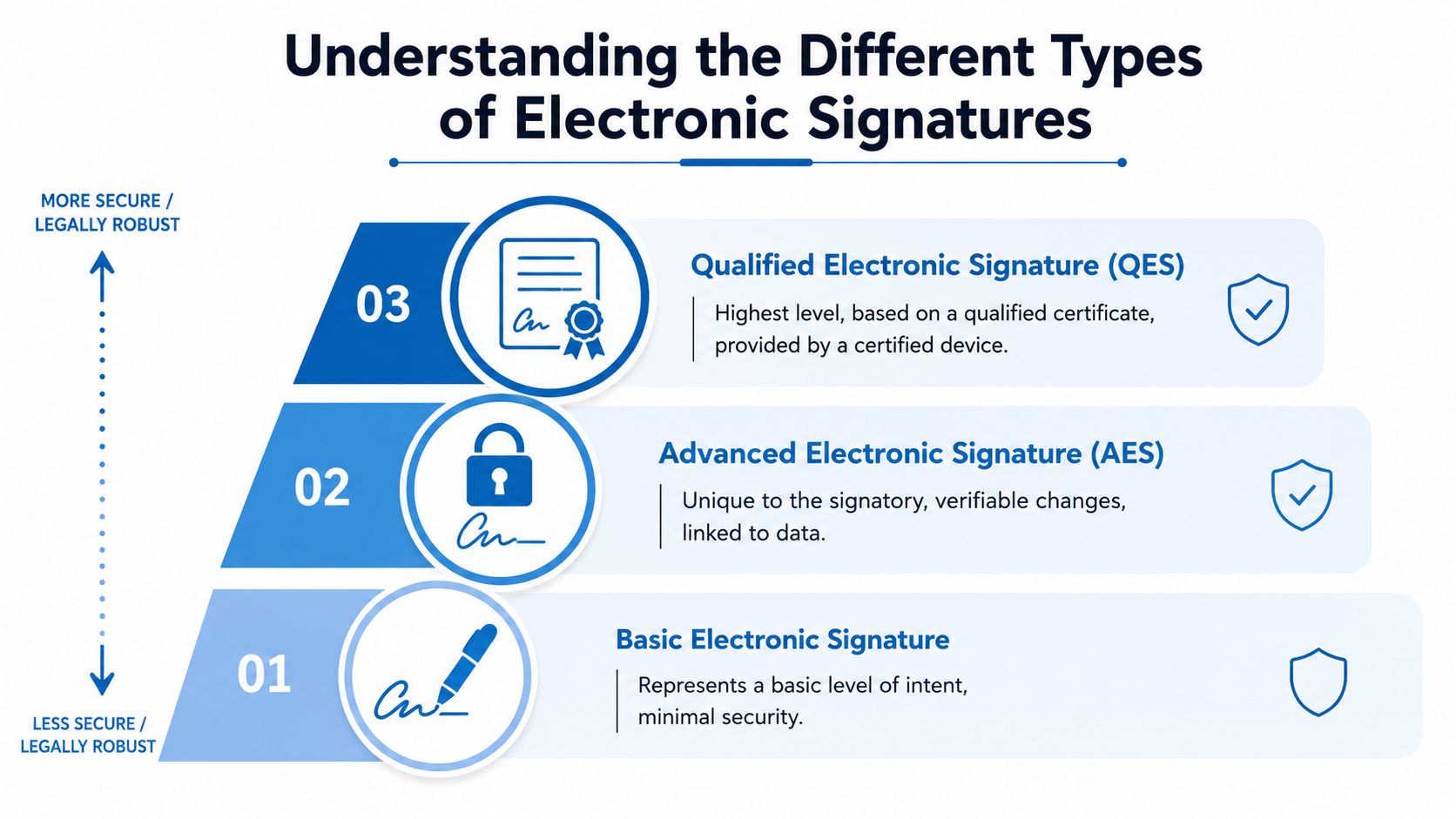
Not all e-signatures carry the same weight. The biggest practical mistake I see is treating every electronic signature tool as interchangeable.
The law often separates the concept of an electronic signature from the method used to create and verify it. That distinction matters because the legal conversation shifts from “was there a signature?” to “how much proof sits behind it?”
Simple electronic signatures
A Simple Electronic Signature, often shortened to SES, is the lightest category. It is comparable to a handshake or an email sign-off. It can show agreement, but if someone later denies it, you may need extra evidence to prove who acted.
Common examples include:
- Typed names: A signer enters their name in a signature field.
- Checkbox acceptance: A user clicks to accept terms or approve a record.
- Uploaded signature images: Someone drops in a scanned signature.
SES can work for internal approvals, routine acknowledgments, or lower-risk agreements. It becomes risky when the transaction value is high, the signer may dispute identity, or regulation requires stronger proof.
Advanced electronic signatures
An Advanced Electronic Signature, or AES, sits in the middle. This is closer to a standard contract with stronger evidentiary backing. The workflow is designed so the signature is more clearly linked to the signer and to the document.
In practical terms, AES usually means the business has added stronger controls such as identity checks, document integrity protections, and audit logging. If the signed document changes, the system should show that.
A stronger signature level doesn't just add technology. It adds evidence.
Qualified electronic signatures
A Qualified Electronic Signature, or QES, is the highest trust level in the EU model. According to Secured Signing's explanation of eIDAS, the strongest legal model globally is the EU's QES framework, and only QES receives the explicit legal equivalence of a handwritten signature across EU member states under that system's tiered trust model in this overview of digital-signature legality.
That's why the usual analogy is useful:
| Type | Rough analogy | Best fit |
|---|---|---|
| SES | Handshake or email sign-off | Low-risk approvals |
| AES | Standard signed contract | Many business agreements |
| QES | Formal notarized-style assurance | Higher-risk EU use cases |
The practical takeaway is simple. Use the lightest method only when the risk supports it. As identity risk, deal value, or regulatory scrutiny rises, the signature method has to rise with it.
How E-Signature Laws Differ Globally
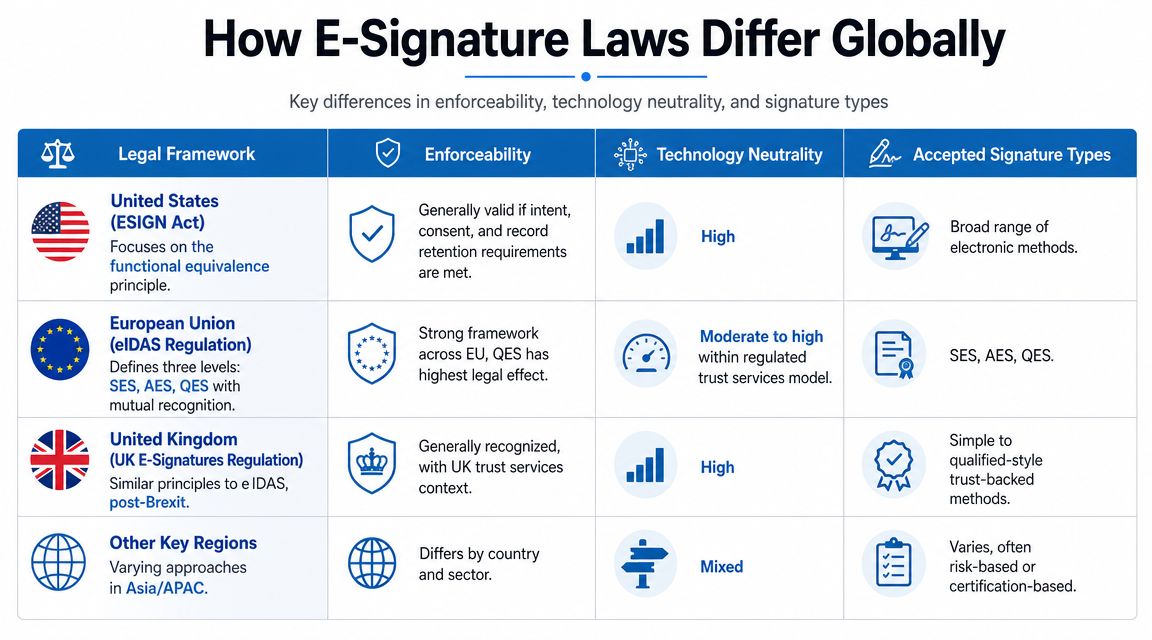
A U.S. company sends a sales agreement through its standard e-sign tool. The counterparty signs from Germany, the goods ship to India, and six months later the parties are arguing over whether the contract was properly executed. The question is no longer whether electronic signatures are legal in general. The question is whether this specific signing method matched the jurisdictions, the transaction, and the evidence burden that comes with a dispute.
E-Signature legal frameworks at a glance
| Jurisdiction | Governing Law(s) | Core Principle | Highest Signature Standard |
|---|---|---|---|
| United States | ESIGN Act and UETA | Electronic signatures generally can't be denied legal effect solely because they are electronic, if the legal elements are met | No single formal tier equivalent to the EU model |
| European Union | eIDAS Regulation | Tiered framework with different levels of assurance and legal effect | QES |
| India | Information Technology Act | Digital signing depends on local legal and technical requirements | Varies by applicable local framework and use case |
The U.S. model
The U.S. framework is broad and technology-neutral. If the process supports a valid agreement, the law usually does not require a particular vendor, certificate type, or branded signing tool.
That flexibility helps businesses move fast. It also creates a common compliance mistake. Teams assume a legally acceptable U.S. workflow will hold up everywhere else, even when the signer is abroad or the document falls into a more formal category.
The EU model
The EU takes a more structured approach. Under eIDAS, electronic signatures are not treated as one flat category. Legal effect and evidentiary strength rise with the assurance level, and Qualified Electronic Signatures receive the clearest statutory recognition. The European Commission explains that framework in its overview of electronic identification and trust services under eIDAS.
For cross-border transactions inside the EU, that structure matters in practice. A low-friction click-to-sign flow may still work for routine approvals, but it gives you less built-in protection if identity, authority, or document integrity is challenged later.
India and cross-border reality
India follows its own legal and technical model, and cross-border deals often break down on execution details rather than on the broad idea that e-signatures are allowed. Governing law, local admissibility rules, industry obligations, and the type of signature used all affect risk.
I usually advise teams to start with the dispute scenario, not the software. Ask where enforcement would happen, who would need to prove authenticity, and what records would survive scrutiny from opposing counsel, an auditor, or a regulator. That mindset is particularly important in healthcare and other regulated fields, where identity proofing, consent records, and chain of custody can matter as much as the signature event itself. The same discipline shows up in adjacent evidence-heavy contexts such as verifying infidelity with digital proof, where the record is only as useful as the documentation behind it.
A few practical rules reduce avoidable risk:
- Match the workflow to the governing law. Do not let the software default decide the legal standard.
- Check the signer location and enforcement venue early. Cross-border disputes often turn on local formalities and evidence rules.
- Raise the control level for regulated records. Healthcare, financial services, education, and procurement usually need stronger identity and retention practices.
- Set the signature standard before circulation. Fixing a weak workflow after a dispute starts is expensive and often impossible.
Global legality is the easy part. Cross-border enforceability depends on whether the process fits the jurisdiction and whether your records prove what happened.
What Makes an Electronic Signature Enforceable in Court
Legality in the abstract is easy. Court enforceability is where the quality of your workflow gets tested.
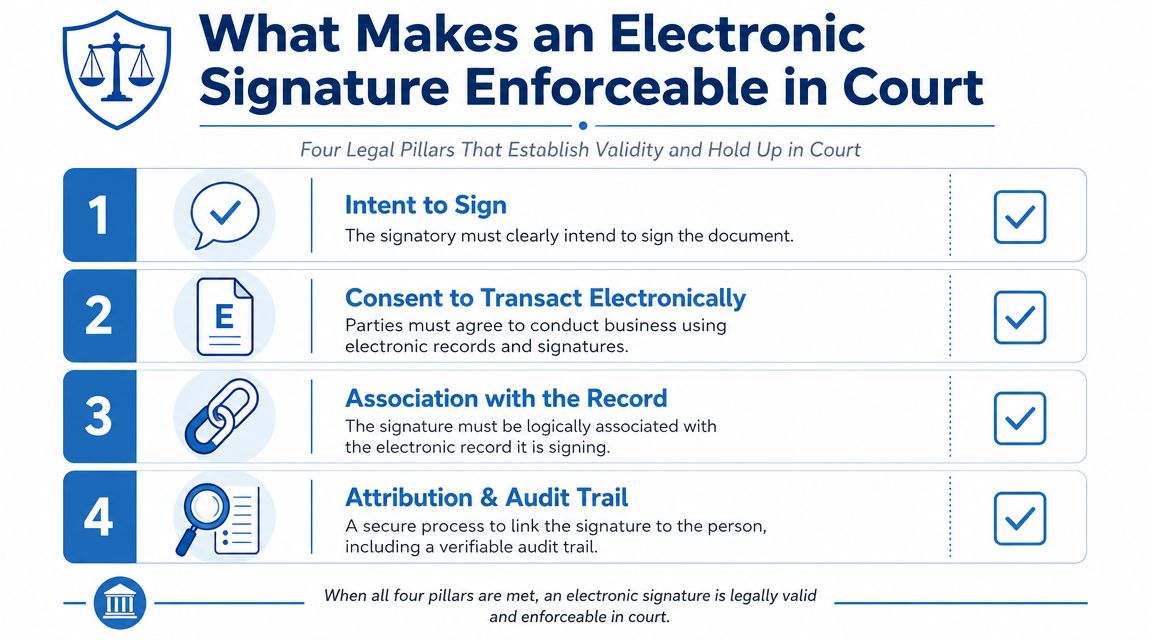
In the U.S., electronic signatures are enforceable under ESIGN and UETA only when the process captures intent to sign, consent to transact electronically, attribution to a specific signer, and secure record retention, as summarized by Purdue Global Law School in its article on e-signature legal requirements. If even one of those is weak, your evidentiary posture gets weaker fast.
The four pillars that matter
Intent to sign
The interface has to make the act of signing unmistakable. “Submit” is weaker than “Sign agreement.” A buried action button invites arguments later.Consent to transact electronically
Parties should affirm that they agree to use electronic records and signatures. This is especially important in consumer-facing or regulated workflows.Attribution to the signer
You need a reliable link between the person and the act. Email alone may be enough in some cases, but higher-risk agreements often need stronger authentication.Secure retention of the record
If you can't reproduce the final signed record and the supporting audit history, your compliance story falls apart.
A sample consent clause
You don't need ornate language. You need clarity. A simple clause often works better:
By proceeding, you agree to receive, review, and sign this agreement electronically, and you consent to the use of electronic records in connection with this transaction.
That clause isn't magic. It works only if the surrounding workflow preserves evidence that the person saw and accepted it.
What solid evidence looks like
A defensible file usually includes more than the PDF. It includes the event history around the PDF.
- Signing event log: When the document was sent, opened, signed, and completed.
- Identity markers: The credentials or verification steps used in the workflow.
- Document integrity controls: Evidence that the signed record wasn't altered after execution.
- Retention method: A stable, retrievable archive of the final record and log.
Chain of custody matters here more than many businesses realize. If you've ever seen digital evidence challenged outside contract law, the same logic applies. This guide on verifying infidelity with digital proof is useful because it shows why documentation of handling, timestamps, and evidence continuity can make or break credibility.
When Electronic Signatures Are Not Enough
The practical question isn't whether e-signatures are broadly legal. It's where that broad rule stops helping you.
A frequently missed issue is that some documents still require special handling or may not be suitable for ordinary electronic execution in certain jurisdictions. SignEasy's discussion of the topic highlights common exceptions such as wills, adoption papers, and some court orders in its article on whether electronic signatures are legal. That's where businesses get caught by assuming operational convenience equals uniform acceptance.
Common exception zones
Some records raise formalities that a standard platform flow may not satisfy:
- Estate documents: Wills and similar instruments often trigger stricter execution rules.
- Family law and adoption records: These frequently sit inside special statutory procedures.
- Court-related filings or orders: Court systems may impose their own signature and submission requirements.
- Notarized or vital records: Extra layers may be required even where e-signing is partly accepted.
The lesson isn't “avoid electronic signatures.” It's “screen the document type before launch.”
Healthcare raises the stakes
Healthcare adds another layer because legality of signature and privacy compliance are separate questions. A patient may be able to sign electronically, but that doesn't mean the workflow is safe for protected health information or strong enough for an audit.
The weak pattern is familiar. A clinic sends intake forms through one tool, discusses care in a consumer video app, stores signed files in another system, and assumes the whole chain is compliant because each part feels digital and modern. That fragmented setup creates avoidable gaps.
For telemedicine teams, the better approach is to evaluate the entire communication and documentation path. If your organization handles patient discussions, consent, scheduling, and document exchange online, it helps to review options specifically built for regulated care delivery, such as these HIPAA-compliant video conferencing platforms.
Operational warning: A valid e-signature can still sit inside a noncompliant workflow.
Encryption matters here as an added feature, but not as a marketing checkbox. It supports confidentiality while records move and while they're stored. In healthcare, that's part of the control environment around the signature. It doesn't replace consent, identity proof, or retention. It reinforces them.
How to Select a Legally Defensible Platform
A contract dispute rarely turns on whether your vendor had an attractive interface. It turns on whether you can produce a clean record that shows who signed, what they signed, when they signed it, and whether the document changed afterward.
That is the standard I use when reviewing e-signature tools. The legal question is usually not whether electronic signatures are allowed in theory. The practical question is whether your platform gives you evidence strong enough to survive a challenge.
What to look for first
Start with proof, not features.
- Audit trails: The system should log each material event, including access, authentication, signature timestamps, IP data where appropriate, and final completion.
- Identity controls: Match the verification method to the document risk. Email-only signing may be enough for low-risk approvals. It is often too weak for regulated consents or higher-value agreements.
- Tamper evidence: A completed file should show whether anyone altered the document after signing.
- Encryption: Sensitive records and signature metadata should be protected in transit and at rest.
- Retention and exportability: You need to retrieve the signed file, certificate, and event history years later without depending on one vendor's interface.
A platform that only captures a mark on a PDF is not enough for serious use.
The cost question that actually matters
Price still matters. The mistake is comparing subscription fees without pricing the legal and operational cost of a weak workflow.
Tool sprawl is where expenses and risk usually rise together. One system handles signatures, another handles client meetings, another stores files, and a fourth handles training. Each handoff creates another place where records can be lost, access controls can break down, or audit history becomes incomplete. In a dispute, that fragmentation is hard to explain and harder to defend.
If your team also signs documents during remote sales calls, onboarding sessions, or client reviews, it helps to assess communication tools alongside signature tools. This guide to the best video conferencing for small business is useful for spotting workflow and cost trade-offs before you add another vendor to the stack.
Why related functions matter
Built-in meetings or webinars are not a substitute for signature evidence. They can still improve compliance operations.
Training is the clearest example. If staff regularly mishandle consent steps, send the wrong version of a form, or skip identity checks, the problem is rarely the signature law itself. It is process failure. Platforms that support onboarding sessions, policy training, or guided customer education can reduce those errors by making the signing process more consistent across teams.
Here is the review checklist I use:
| Priority | What to verify |
|---|---|
| High | Can it show who signed, what they signed, and when |
| High | Can it produce an audit-ready record without manual reconstruction |
| High | Can it protect sensitive documents and metadata during transfer and storage |
| Medium | Does it reduce workflow fragmentation across signing, communication, and storage |
| Medium | Does it include related functions such as meetings or webinars that lower separate vendor risk |
Choose the platform that preserves evidence, not the one with the longest feature list. That is what makes the difference between a signature that looks valid and a process you can defend.
Putting It All Together A Practical Summary
The legality of electronic signatures isn't a yes-or-no topic in day-to-day business. The law in major markets already gives you a path to valid digital execution. The risk sits in how carelessly or carefully you use that path.
If you want a practical rule, use this one: the signature mark matters less than the signing system.
A sound process does four things well. It captures intent clearly. It gets consent to transact electronically. It ties the act to the right person. It preserves the final record in a way you can retrieve and defend later. If your workflow misses one of those, you're relying on hope more than evidence.
For regulated teams, there's one more layer. You also have to screen for document exceptions, jurisdiction issues, and sector rules that sit around the signature itself. Healthcare is the clearest example because privacy, retention, and secure communications all matter alongside the signature event.
Use this closing checklist:
- Classify the document first: Routine approval, commercial contract, regulated consent, or special-formality record.
- Match the signature method to the risk: Don't use the weakest option by default.
- Test the evidence package: Pull a completed file and ask whether it would satisfy a dispute, audit, or internal investigation.
- Check the surrounding workflow: Meetings, document exchange, storage, and access controls all affect enforceability in practice.
- Prefer systems that reduce fragmentation: Fewer handoffs usually mean fewer gaps.
Businesses don't lose these disputes because e-signatures are weak on their own. They lose because their process was casual, inconsistent, or poorly documented. Get the process right, and digital agreements are not just convenient. They're dependable.
If you want one platform that supports secure client meetings, HIPAA-conscious workflows, built-in webinars, document sharing, recordings, and bank-level encryption without typical enterprise cost friction, take a look at AONMeetings. Plans start at ₹179 per user per month, include unlimited meeting time and webinars, and can help teams avoid paying separately for multiple tools while keeping their digital agreement workflow cleaner and easier to document.
