
A CAN-SPAM violation can cost up to $53,088 for each separate commercial email. That's not per campaign. It's per email, which means a sloppy marketing blast can turn into a serious financial problem fast.
Most business owners still treat CAN-SPAM like a minor email housekeeping rule. That's a mistake. If you promote products or services by email, including B2B outreach, newsletters, automated sequences, webinar invites, or sales follow-ups, this law applies to you. The Federal Trade Commission makes that point clearly in its CAN-SPAM compliance guide for business.
The practical takeaway is simple. Email compliance isn't just a legal box to tick. It's part of how you protect your brand, keep your systems disciplined, and show customers you can be trusted with communication. The companies that get into trouble usually don't start with fraud. They start with messy lists, rushed campaigns, unclear ownership, and automated tools nobody properly audits.
The High Stakes of Email Marketing Compliance
If your team sends commercial email, you have legal exposure. It doesn't matter whether you're a solo consultant, a healthcare clinic, a SaaS company, or a training business promoting events. If the message's primary purpose is advertising or promoting a product or service, CAN-SPAM is in play.
That broad scope catches more businesses than people expect. Owners often assume the law targets only obvious spam operations. It doesn't. Routine marketing emails can trigger liability when teams use misleading subject lines, inaccurate sender details, weak unsubscribe processes, or campaigns that keep sending after someone opts out.
Why this matters beyond fines
The law matters because email is rarely isolated. It's tied to your CRM, your webinar platform, your sales process, your customer support team, and your brand reputation. One weak workflow can create a chain reaction. Marketing uploads a list. Sales launches a sequence. Operations forgets to sync suppression data. The customer keeps getting promotional messages after opting out. Now you have a compliance problem and a trust problem.
Practical rule: If your unsubscribe process depends on manual cleanup, it's already too fragile.
There's also a broader business issue. The same companies that handle opt-outs poorly often handle security poorly. That's why I advise clients to think bigger than email law. Build a communication stack that favors consent, clean records, and secure delivery. If you're evaluating event and outreach channels, this guide to webinar software for small business is useful for shifting from cold promotion toward more permission-based audience building.
The real operational risk
Here's where owners get blindsided:
- Marketing risk: A campaign goes out with a subject line that overpromises.
- Sales risk: Reps use outreach templates with unclear sender identity.
- Automation risk: Old contacts stay in a sequence after opting out.
- Vendor risk: An outside agency sends on your behalf and assumes nobody will check.
None of that feels dramatic in the moment. But regulators don't care whether the violation came from carelessness or chaos. They care that the message broke the rules.
How CAN-SPAM Fines Are Calculated
One noncompliant email can carry a civil penalty of up to $53,088. Regulators do not look at a bad campaign and call it one mistake. They can assess penalties per email, which is why small process failures turn into expensive legal exposure fast.
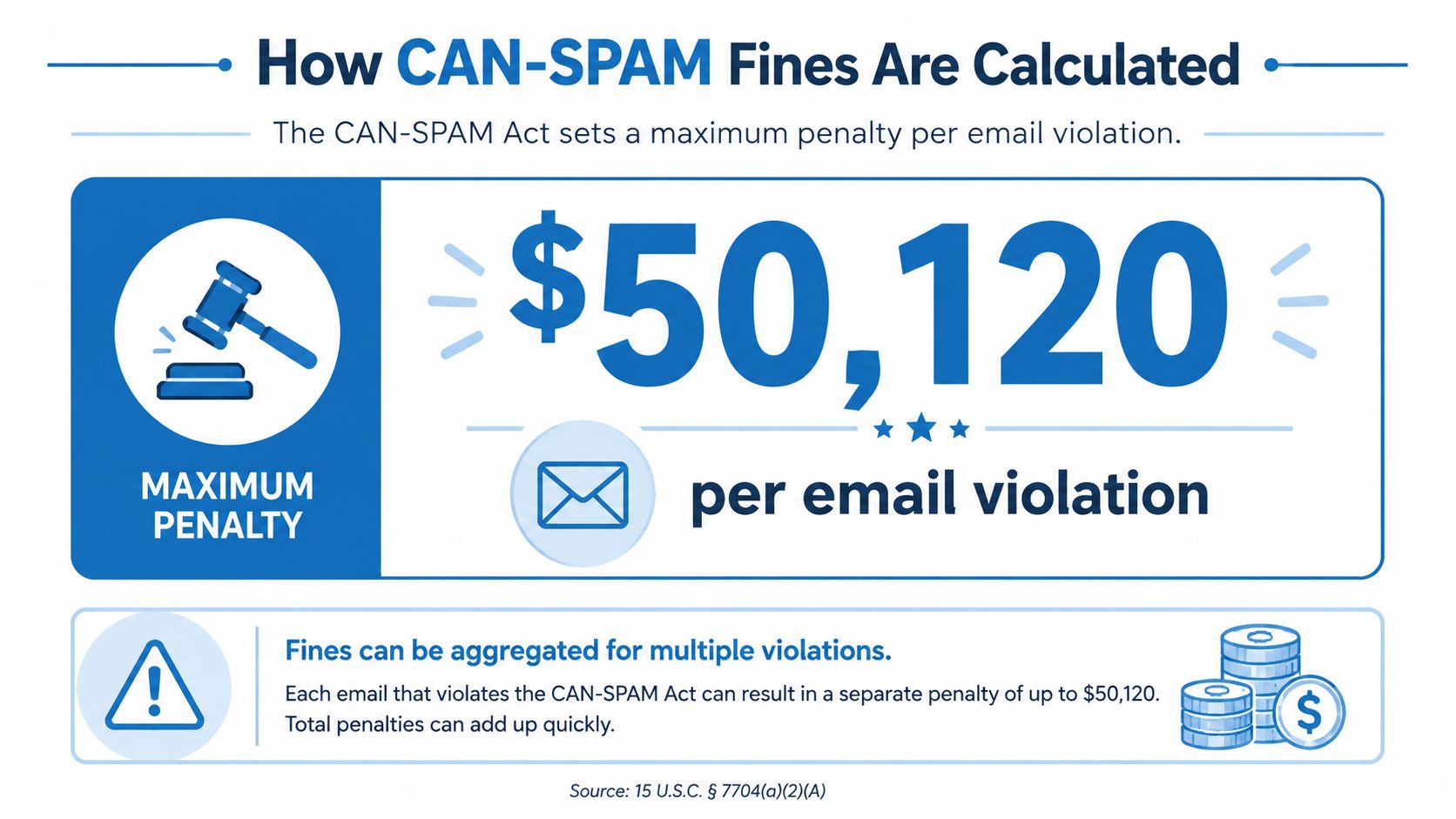
Per email means the math gets ugly fast
If a flawed message goes to 5,000 people, your risk is tied to 5,000 sends, not one campaign record in your dashboard. That is the point business owners miss. Volume magnifies mistakes.
Automation makes this worse. A broken footer, misleading subject line, or failed suppression sync can keep firing across email drips, follow-ups, webinar promotions, and re-engagement sequences until someone stops the system. Software does not slow down when your compliance controls are weak.
One bad template can spread legal exposure across your list in minutes.
What usually triggers a violation
The common triggers are operational, not exotic legal traps. In audits, I see the same failures over and over:
- Misleading header information: The “from,” routing, or reply-to details do not clearly identify the sender.
- Deceptive subject lines: The subject overstates, obscures, or misrepresents what the email contains.
- Missing opt-out method: The message does not give recipients a clear, workable way to stop future commercial emails.
- Failure to honor opt-outs: The business keeps sending promotional email after the recipient unsubscribed.
These are basic control failures. They usually come from sloppy templates, disconnected tools, and poor review standards.
Why your communication stack matters
The operational risks are where owners get blindsided:
If your CRM does not sync suppression data with your email platform, you can keep mailing people who already opted out. If your webinar registration system feeds contacts into sales automation without consent rules and list controls, you create the same problem in a different channel. If an agency reuses old campaign assets, a bad sender identity or outdated footer can spread across multiple sends before anyone checks.
That is why CAN-SPAM compliance should sit inside a broader digital communication policy. Secure, permission-based systems reduce legal risk because they create cleaner records, tighter list controls, and fewer opportunities for unauthorized or misleading outreach. A compliant webinar platform, for example, is not just a marketing tool. It can help you collect consent properly, control follow-up workflows, and prove that your audience engagement process is built on trust instead of blast tactics.
Who Can Be Held Liable for Violations
A lot of owners assume the person who physically sends the email is the one carrying the risk. That's too simplistic.
The FTC says more than one person may be held responsible for CAN-SPAM violations. In practice, that means liability can spread across the business promoting the offer and the outside party executing the campaign. If your brand benefits from the email, you shouldn't assume a vendor absorbs the problem for you.
A common agency scenario
Take a healthcare clinic that hires a marketing firm to promote a new telehealth service. The agency writes the emails, loads the list, and presses send. The clinic owner barely reviews the campaign because the agency “handles marketing.”
Now assume the subject line is misleading, the sender details are vague, and unsubscribe requests aren't processed correctly. The clinic can't shrug and say, “Our agency did it.” The promotion served the clinic's business. The agency may face scrutiny, but the clinic can too.
That's the practical meaning of shared liability.
Where businesses go wrong
Most companies create this risk in predictable ways:
- They outsource execution without oversight.
- They approve goals but not templates.
- They don't demand proof that opt-outs are honored.
- They let separate teams run separate lists.
Those are management failures, not just marketing failures.
If someone emails prospects for your business, that process belongs on your compliance radar even if they sit outside your payroll.
What smart owners do instead
You need a vendor-control mindset. Before anyone sends commercial email on your behalf, require clarity on four points:
- Who owns the list hygiene
- Who processes opt-outs
- Who approves copy and subject lines
- Who keeps records of what was sent and when
Then test it. Ask to see the templates. Ask how suppression lists work. Ask how they distinguish commercial email from transactional messages. Ask who monitors ongoing compliance after launch.
If a partner gets defensive, that's your answer.
The biggest misconception in this area is that delegation reduces responsibility. It often does the opposite. Delegation widens your risk surface unless you control it.
Real-World Enforcement and Expensive Mistakes
Here's the uncomfortable truth. Many articles on can spam fines talk confidently about enforcement examples, settlement amounts, and headline-grabbing cases without verifying them. That's dangerous. If you're making decisions about legal risk, you need disciplined facts, not recycled internet folklore.
I'm not going to invent enforcement stories to make the point sound dramatic. I don't need to. The FTC's penalty framework is already severe enough, and the operational mistakes that create exposure are common in ordinary businesses.
The expensive mistakes I see most often
Instead of pretending every violation starts with a villain, look at the mistakes that repeatedly put firms in the danger zone:
- Bad list imports: Old contacts, purchased leads, or scraped addresses enter your system without proper review.
- Template drift: Teams reuse old email templates that no longer include compliant unsubscribe language or accurate sender details.
- Agency opacity: A third party runs campaigns, but nobody checks the copy, audience source, or suppression process.
- Broken workflow handoffs: Webinar signups, CRM contacts, and email platforms don't sync preferences correctly.
- Sales-marketing conflict: Marketing honors an opt-out. Sales keeps emailing from another system.
Those are expensive because they're systemic. One-off errors can be fixed. Process failures keep generating more risk.
Cost of non-compliance vs proactive compliance
The cheapest compliance move is almost always building disciplined systems before your team scales outreach.
| Scenario | Potential Cost | Notes |
|---|---|---|
| One noncompliant commercial email | Up to $53,088 | FTC states the civil penalty can apply to each separate violating email under the CAN-SPAM Act. |
| Large noncompliant campaign | Very large exposure | Penalties are assessed per email, not per campaign, so exposure can grow quickly across a big send. |
| Weak vendor oversight | Qualitatively high | More than one party may be held responsible, which can pull both client and agency into the problem. |
| Secure webinar and meeting platform with built-in webinars, encryption, and predictable pricing | Starting from ₹179 per user per month | A straightforward communications stack is usually cheaper than cleaning up preventable compliance failures. |
Practical example
Say a training company promotes a webinar through email. Marketing exports a list from one system, sales adds prospects from another, and an assistant uploads everything into an email tool. The webinar invitation goes out with a promotional subject line, but the unsubscribe link doesn't work for a subset of recipients because the wrong template was cloned.
That's not a rare story. It's normal business chaos. It's also exactly why compliance needs ownership.
The better comparison isn't “fine versus no fine.” It's disorder versus process. Businesses that invest in secure communication workflows, encrypted platforms, and integrated webinar operations usually reduce friction at the same time they reduce legal risk. That's the core value proposition. Better systems don't just help you avoid trouble. They make your outreach cleaner and easier to manage.
Your CAN-SPAM Compliance Checklist
Most businesses don't need a legal memo. They need a repeatable operating checklist that marketing, sales, and operations can all follow.
Start with this and treat it as mandatory.
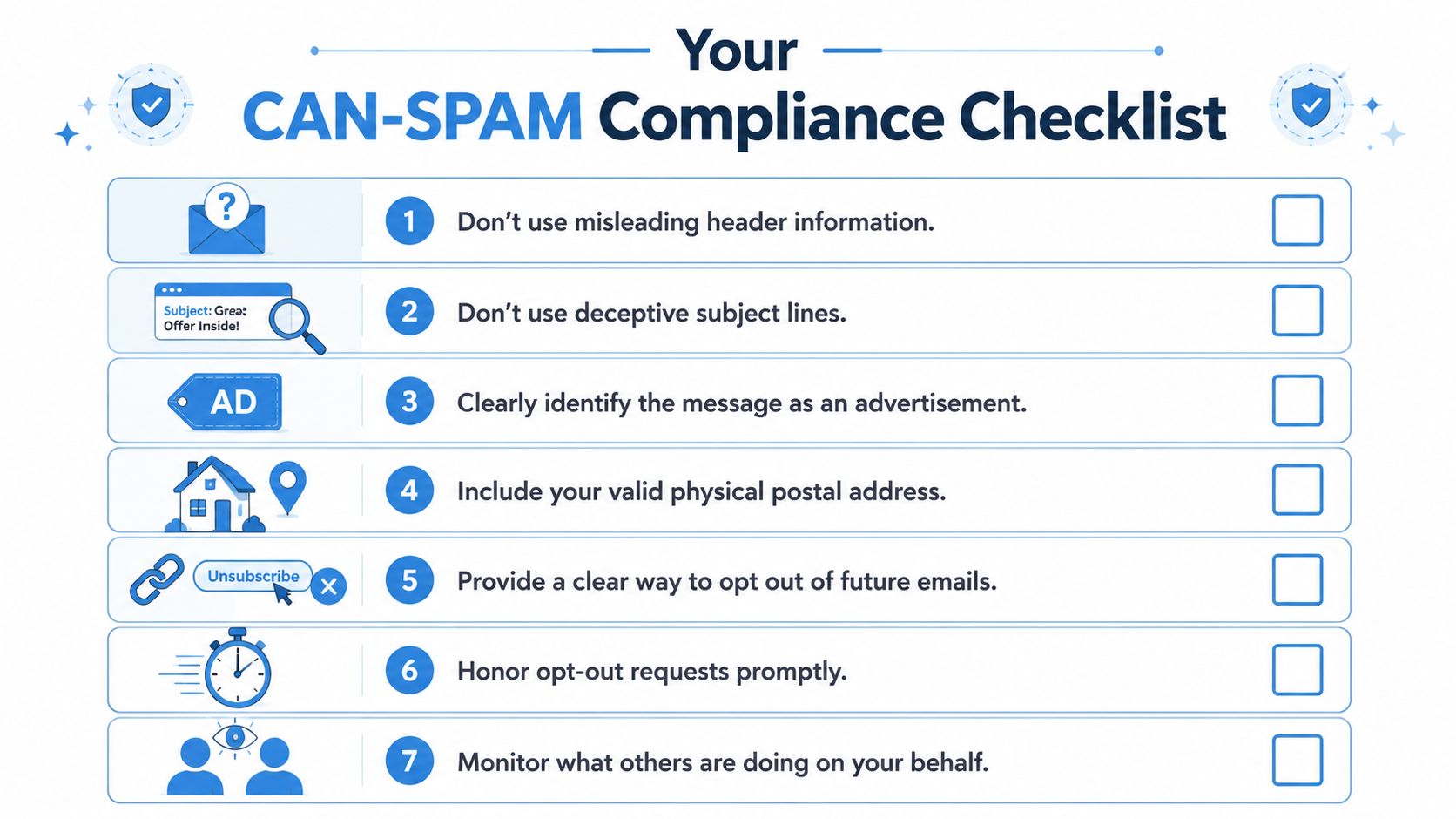
Get the basics right every time
Use accurate header information
Your “from,” “to,” reply path, and routing details should accurately identify the sender. Don't hide behind vague aliases or misleading mailbox names. If the recipient can't tell who contacted them, you're asking for scrutiny.Write subject lines that match the message
Clever is fine. Misleading isn't. If the email promotes a webinar, don't frame it like a private account notice or a personal follow-up that never happened.Make the promotional nature clear
If the email is an ad, treat it like one. Don't play games with ambiguity. Many teams get into trouble because they try to disguise marketing as relationship-building.
Build an unsubscribe process that actually works
Include a valid physical postal address
This sounds old-fashioned, but it still matters. Put it in your footer and keep it current.Offer a clear way to opt out
Your unsubscribe option should be easy to find and easy to use. Don't force a login. Don't make people hunt.Honor opt-out requests promptly
Many businesses fail operationally here, not legally. The law means nothing if your systems don't sync. Keep a suppression list that all sending tools respect.
If a contact wants to stop hearing from you and also wants more control over how their data is used, it helps to understand how people can exercise data rights across commercial data environments. That broader mindset improves your handling of email preferences too.
Operational advice: Unsubscribe handling should be automatic by default and manually audited as a backup.
Control the people and tools around the email
- Monitor what others do on your behalf
Agencies, freelance marketers, SDR firms, and affiliate partners can create compliance exposure for your business. Review their templates, test their unsubscribe flow, and require documented procedures.
Here's a practical way to lower risk without leaning so heavily on cold outreach. Build more opt-in demand through educational events. This guide on how to increase webinar attendance is useful because it pushes teams toward content people choose to engage with, instead of constant unsolicited promotion.
A secure communication strategy also matters here. If you host webinars or customer education sessions, choose tools that include encryption and strong access controls. Security doesn't replace CAN-SPAM compliance, but it reinforces the same trust signal. You're telling prospects and customers that your business communicates clearly, protects information, and respects boundaries.
A quick internal test
Before any campaign goes live, ask:
- Can the recipient immediately identify us?
- Does the subject line accurately reflect the content?
- Can the recipient opt out without friction?
- Will every system honor that opt-out?
- Have we reviewed any vendor involved in sending?
If your team can't answer yes to all five, don't launch yet.
Beyond CAN-SPAM State and International Rules
CAN-SPAM is the floor, not the ceiling.
A lot of U.S. businesses act as if federal email law is the whole compliance picture. It isn't. Once you handle personal data across states, industries, or countries, the rule set gets wider fast. Email may be the trigger, but privacy, consent, data rights, and security quickly become part of the same conversation.
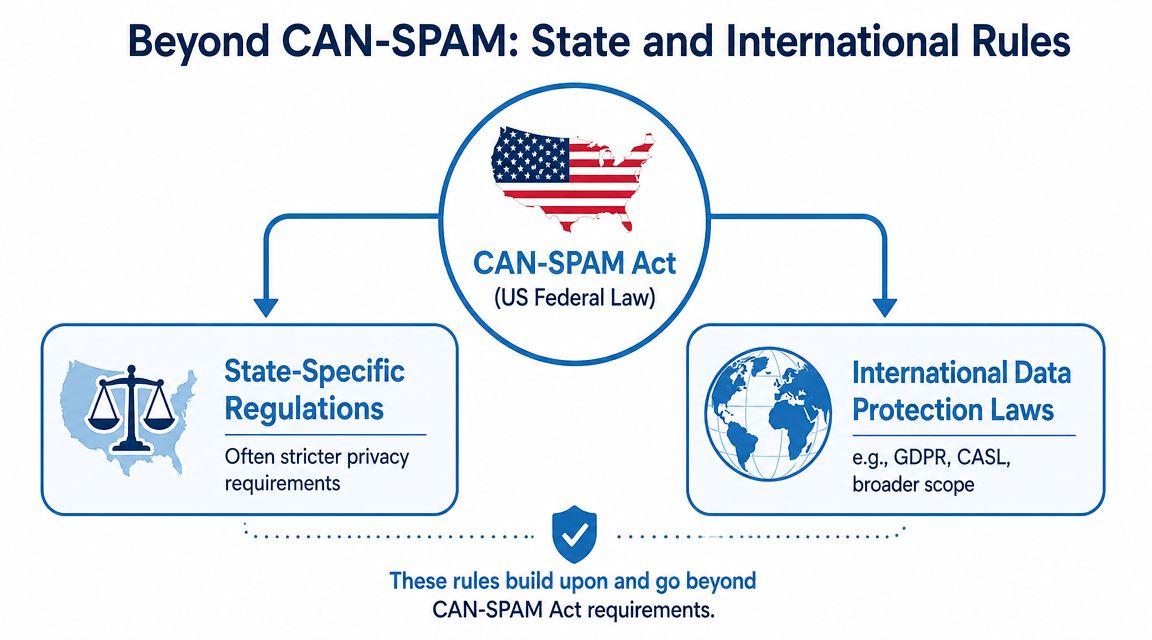
State rules raise the standard
In the U.S., state privacy laws can affect how you collect, store, share, and act on contact data, even when CAN-SPAM governs the email itself. If you gather registration details through webinars, intake forms, lead magnets, or appointment requests, your obligations may extend well beyond sender transparency and unsubscribe mechanics.
That matters for regulated industries in particular. Healthcare providers, telemedicine clinics, and other sensitive-data organizations shouldn't treat marketing compliance and secure communications as separate silos. This is why many teams evaluating outreach workflows also look at HIPAA-compliant video conferencing platforms when they review the broader communication stack.
International rules can be stricter
If you email contacts outside the United States, you need a wider lens. Canada's anti-spam regime and European privacy rules are often stricter than CAN-SPAM in practice, especially around consent and personal data handling.
For teams trying to align list management with broader privacy expectations, this overview of GDPR compliance for email is a useful reference point. The core lesson is simple. A U.S.-legal email approach might still be inadequate for an international audience.
The easiest way to reduce cross-border confusion is to adopt cleaner list practices than the bare minimum required under U.S. law.
Why secure communication belongs in the same strategy
This is the overlooked connection. Email compliance, privacy compliance, webinar registration practices, and encryption all live in the same trust system.
If your company collects signups through forms, hosts educational webinars, follows up by email, stores recordings, and routes data through multiple vendors, regulators and customers will judge the whole process, not just one message. Businesses that separate “marketing rules” from “security rules” create gaps. Businesses that treat digital communication as one governed system usually make better decisions.
That's the angle most companies miss. CAN-SPAM compliance is important, but mature businesses don't stop there. They build communication workflows that are transparent, permission-aware, and secure by design.
How to Respond to a Violation Notice
A violation notice is a legal and operational problem at the same time. Treat it like an incident response event. Your goal is to stop additional exposure, preserve evidence, understand what failed, and show that your business is capable of fixing the problem in a disciplined way.
Speed matters. Sloppy reactions make things worse.
Do four things first. Pause every campaign, automation, and audience segment tied to the notice, not just the single email someone complained about. Put a legal hold on relevant records so nobody deletes templates, audience exports, unsubscribe logs, CRM notes, approval threads, or vendor messages. Assign one internal owner, usually the person who controls marketing operations or compliance, to coordinate facts. Then contact outside counsel with the right background. Do not call a general business lawyer who handles contracts and employment issues. Use a lawyer with direct experience in FTC matters, advertising law, privacy compliance, or regulatory investigations involving digital marketing.
Come prepared for that first call. Counsel will need the notice itself, the exact emails sent, subject lines, send dates, recipient criteria, suppression and unsubscribe records, screenshots of forms and landing pages, the names of vendors involved, and a timeline of who approved what. If an agency built or sent the campaign, say that immediately. If webinar registrations fed those emails, include the registration flow, confirmation language, and any consent disclosures shown to attendees. That broader communication trail matters because regulators will look at the full system, not just one message.
Do not let employees freelance a response. They should not reply casually to the complainant, edit old records, rewrite templates, or clean up lists before you know what happened. Those moves can destroy evidence or create the appearance that your company is hiding facts.
What the internal review should actually look like
A useful internal review is not a meeting where everyone says the unsubscribe link "should have been there." It is a documented reconstruction of the campaign.
Start with the message itself. Pull the exact version that was delivered, including headers, footer language, sender name, reply-to address, and the landing page it pointed to. Then trace the recipient path. Where did the list come from? Was it imported from a tradeshow, webinar signup, CRM segment, partner upload, or purchased source? Which filters were applied? Which suppression rules were supposed to run? Which system sent the message?
Next, identify decision points. Who wrote the copy? Who approved the audience? Who turned the automation on? Which platform handled unsubscribes? Which vendor was responsible for list hygiene or webinar registration capture? If three teams touched the campaign, you need all three in the review. Fragmented ownership is one of the main reasons violations repeat.
Here is what that review looks like in practice. A SaaS company receives a notice after a product webinar follow-up campaign. Marketing says recipients registered for the event. Sales says the list also included older leads who never attended. Operations finds that the webinar platform captured new opt-outs correctly, but an agency exported the list into a separate email tool that did not sync the suppression file. Result: people who had already unsubscribed got the follow-up sequence anyway. That is the kind of process failure you need to find, document, and fix.
Your internal review should answer these questions clearly:
- What exact message or sequence triggered the notice?
- Which audience received it, and how was that audience built?
- Were the sender identity, subject line, and opt-out method compliant?
- Were unsubscribe requests processed correctly and on time?
- Which employee, agency, or vendor approved and executed the send?
- Is this a one-off mistake or a symptom of a wider control problem?
Check for spillover immediately. Review sales nurtures, re-engagement drips, webinar follow-ups, event reminders, affiliate campaigns, and any dormant automations nobody has audited in months. One broken workflow often points to several more.
How to communicate while the review is underway
Use one channel for legal coordination and one channel for operational work. Keep facts organized. Keep opinions out of email. If counsel decides a response is needed, it should be accurate, narrow, and supported by records.
Your posture should be cooperative and controlled. Regulators and complainants notice when a company can produce timestamps, suppression logs, approval records, and a clear remediation plan. They also notice chaos. Disorganized teams tend to contradict themselves, miss deadlines, and expose larger problems than the original complaint.
Do not guess. Do not minimize. Do not blame a vendor before you confirm the facts.
What remediation should include
Fix the root cause, not just the single campaign. If the issue came from poor list syncing, repair the integration and test it. If the issue came from unclear signup language, rewrite the form and capture screenshots of the updated version. If an agency sent messages outside your rules, tighten approvals and contract terms. If your webinar and email systems pass data back and forth, audit that handoff carefully. Secure communication tools help only when they are configured and governed properly.
This is where the broader strategy matters. Businesses that treat email, webinar registration, follow-up sequences, and data security as one governed communication system recover faster and make fewer repeat mistakes. A compliant webinar platform with clear registration disclosures, controlled attendee data, and secure follow-up workflows reduces the odds of list confusion and bad recordkeeping in the first place.
Document every corrective action. Keep dated notes on what you paused, what you reviewed, what you changed, who approved the fix, and how you verified it worked. If the issue resurfaces later, those records can matter almost as much as the original campaign evidence.
AONMeetings fits that broader risk-reduction approach. AONMeetings combines secure video meetings, built-in webinars on all plans, and bank-level encryption in a browser-based platform with straightforward pricing starting from ₹179 per user per month. For businesses that want tighter control over digital communication without adding bloated enterprise software, that is a practical option.
Discipline wins here. Fast containment, the right lawyer, a real fact review, and documented fixes give you the best chance to contain the damage and prevent a small notice from turning into a bigger enforcement problem.
