
A phone decision used to be simple. You installed a line at the front desk, put the number on your business card, and moved on. That no longer works for many clinics, firms, and small teams because the phone system now affects scheduling, compliance, client response time, remote work, and software integration.
The numbers behind that shift are hard to ignore. In the United States, 71.7% of adults were wireless-only, about 183.2 million Americans, compared with 27.9% in 2010, according to a national analysis summarized alongside CDC reporting on the wireless transition in the National Health Interview Survey early release. That isn't just a consumer preference trend. It signals a bigger operational change. People expect communication to move with them.
Still, landlines haven't become irrelevant. A solo attorney may want a stable office endpoint. A clinic may want a fixed number tied to a known location. A home office owner may also be reevaluating how phone and internet fit together, especially if they're moving away from bundled legacy service. If that's your situation, SwiftNet Wifi's guide to modern home internet is a practical companion read because the phone decision and the connectivity decision are often linked.
What matters in a landline vs mobile decision now isn't nostalgia or trend-chasing. It's total cost of ownership, security posture, workflow fit, and failure mode. For a healthcare practice, that includes HIPAA exposure and encrypted communications. For a small business, it includes whether calls can flow into scheduling, CRM notes, or team collaboration without extra manual work. For a school or coaching center, it includes whether one platform can support both calls and live sessions.
The Great Communication Shift
A front desk used to be the center of business communications. For many small practices and firms, that assumption no longer holds.
I saw this clearly with a pediatric office that treated one main desk phone as the hub for scheduling, billing callbacks, refill requests, and patient questions. The setup looked inexpensive because the monthly line charge was predictable. However, costs emerged in missed handoffs, sticky notes, voicemail bottlenecks, and staff time spent chasing context across rooms and devices. Once the practice needed calls to follow the employee handling the task, the fixed line stopped matching the workflow.
That is the communication shift that matters for owners. The decision is no longer just landline versus mobile as a hardware choice. It is fixed endpoint versus portable, software-connected communication tied to the person doing the work.
For regulated and client-facing businesses, that changes the buying criteria. A clinic has to consider HIPAA exposure, device control, call routing, and whether messages stay inside an approved system. A law office or accounting firm has to consider documentation, call logs, after-hours coverage, and how quickly staff can return calls without using personal numbers. A single missed call can become rework, delayed revenue, or a privacy problem.
The phone bill alone will not show that risk.
A landline can still make sense when one location handles most inbound traffic and the process stays at a reception desk. It gives you a fixed number, familiar hardware, and a straightforward calling pattern. That simplicity is useful in some offices.
But many owners now need a phone setup that works across rooms, remote days, field visits, and shared responsibility. In those cases, total cost of ownership includes more than service fees. It includes maintenance, handset replacement, staff labor, compliance controls, training time, and whether the system connects cleanly to scheduling, CRM, or team messaging. If you are also rethinking whether internet and phone service still need to be bundled, SwiftNet Wifi's guide to modern home internet is a practical reference because connectivity choices often shape the phone decision too.
The better question is simple: which setup reduces manual work, protects sensitive information, and lets your team respond without friction? That standard usually leads to a better answer than comparing call quality in isolation.
What changed for business owners
The older phone model assumed a place. The current model has to support a person, a device, and a business process.
That changes how owners should judge communications:
- Operational reliability: Does the system work where staff answer, transfer, and document calls?
- Security and compliance: Can you control access, keep business calls off personal devices, and protect regulated information?
- Workflow fit: Can calls connect to appointments, follow-up tasks, client records, or internal collaboration without duplicate entry?
- Long-term cost: Are you paying only for dial tone, or for a setup that reduces admin time and supports the way your team works?
Practical rule: Choose the option that creates fewer handoffs, less manual logging, and tighter control over client or patient information.
Why landlines still stay in the conversation
Landlines stay in the discussion because they solve a specific problem well. They anchor communication to one known location.
That still matters for a reception desk, a lobby phone, or a small office with stable staffing and a simple call flow. But once work moves between people, rooms, or devices, a fixed line often adds hidden labor before it adds obvious telecom cost. That is why the modern landline versus mobile decision is really a workflow and risk decision, not just a technology preference.
Understanding the Core Differences Today
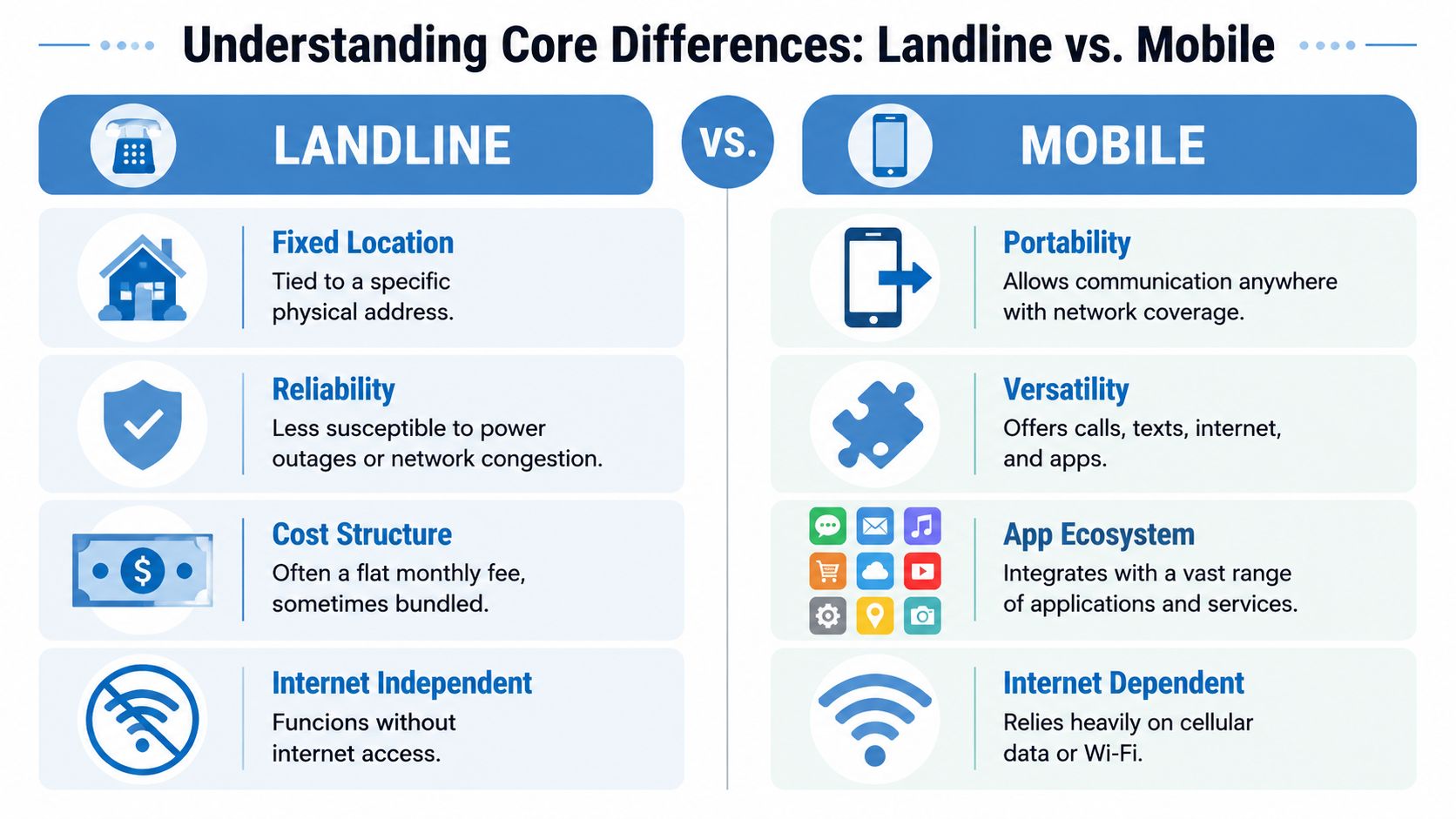
Before comparing features, it helps to separate the two systems by design. A landline is built around a fixed endpoint. A mobile setup is built around reach, portability, and layered digital services.
Early in the evaluation, I usually show owners a simple side-by-side view like this.
| Factor | Landline | Mobile |
|---|---|---|
| Primary location | Fixed office or reception point | Wherever the user has coverage |
| Best fit | Single stable desk or front office | Distributed staff, field work, flexible coverage |
| Core strength | Predictable fixed-location calling | Mobility and multi-purpose communication |
| Main trade-off | Limited flexibility and expansion | Performance varies by signal and network conditions |
| Workflow impact | Usually separate from business apps | Easier to connect with modern tools and team processes |
Why landlines haven't disappeared
Landline use is uneven, not extinct. Across 17 international markets, 22% of consumers said they have and use a landline, while another 18% had one but did not use it, according to YouGov's international landline survey. The same survey found large differences by market, including 55% in Germany, 24% in the UK, 19% in the US, and 12% in India.
In the U.S., landlines also persist by age. 50.5% of Americans aged 65 and over still had a landline at home, which tells you something important for healthcare and professional services. If your clients skew older, a landline number may still feel more trustworthy and familiar to them.
The philosophical difference
A landline emphasizes stability through fixed infrastructure. A mobile phone emphasizes availability through personal access.
That sounds abstract until you look at daily operations:
- A receptionist at one desk may prefer a landline because the work stays anchored.
- A home health coordinator, realtor, consultant, or partner moving between office and court won't.
- A small clinic with staff sharing rooms may need both a stable published number and mobile reach behind the scenes.
Landlines persist where fixed-location communication still maps neatly to the work. Mobile wins where the work itself moves.
What owners often miss
This is not only a technology decision. It's a service-design decision.
If the business depends on one person always being in one spot, a landline can still fit. If calls need to follow the responsible person, not the building, mobile has the advantage. That's why a landline vs mobile discussion now belongs in operations planning, not just telecom purchasing.
A Detailed Comparison for Professional Use
When owners ask me to compare landline vs mobile for a real business environment, I reduce it to four tests: reliability, cost, security, and emergency handling. Most bad phone decisions happen because buyers focus on only one of those.
Reliability and call quality
Landlines still have a technical advantage in one narrow but important area. Traditional telephony uses circuit-switched networks that establish a dedicated physical path for the call, which makes voice quality more consistent and predictable than mobile systems that must deal with radio conditions and network variability, as described in this comparison of landline and mobile phones.
In plain terms, a front desk on a stable line is hard to beat for fixed-location calling.
Mobile service is different. It's strong when your staff needs to answer from anywhere, but performance depends on coverage, handoff behavior, and local congestion. That means mobile often delivers the better business result overall, while the landline may still deliver the more predictable single call at one desk.
Where that matters in practice
- Medical reception desks: A fixed endpoint can reduce dropped or inconsistent conversations at intake.
- Field services and mobile teams: Mobility matters more than deterministic call quality.
- Hybrid offices: Staff often prefer mobile or app-based calling because calls follow the user.
If missed calls happen because nobody is sitting at the desk, the cleanest landline audio in the world won't solve your problem.
For owners comparing legacy systems with newer options, Networking2000's definitive guide to business phone systems is useful because it frames the buying decision around real operating conditions rather than nostalgia.
Cost and total cost of ownership
Many landline setups fall short. A simple line can look inexpensive because the bill is easy to understand. But the true cost includes the desk phone, wiring dependence, admin effort, missed-call risk, and the fact that a single-purpose line often forces you to buy separate tools for meetings, collaboration, and follow-up.
By contrast, modern mobile and internet-based communications can consolidate functions. You may replace a desk-only number, reduce dependence on on-site routing, and fold voice into a broader communication stack.
The one concrete comparison available here is from the publisher's product information: AONMeetings starts from ₹179 per user per month and includes unlimited meeting time, webinar hosting, screen sharing, whiteboards, document sharing, recordings, and bank-level encryption. That matters because many buyers still compare a line to a line, when they should compare a line to a workflow platform.
A practical budgeting lens:
- Landline value: Best when you need one stable endpoint and very little else.
- Mobile value: Best when staff mobility reduces missed calls and delays.
- Platform value: Best when communication, meetings, and collaboration should live together.
If your team also runs remote consults or internal huddles, basic telephony may not be enough. In that case, understanding how to make a teleconference call becomes part of phone planning, not a separate project.
Security and privacy
Landlines have fewer internet-based attack surfaces because they don't route calls over the internet in the same way modern digital systems do. That's their cleanest security argument.
But that does not automatically make them the better choice for a regulated business. A clinic, therapist, accountant, or law office also needs access controls, encryption, user management, and auditable process discipline. Those controls usually live better in a modern platform than in an analog environment.
For healthcare in particular, the useful question isn't “landline or mobile?” It's this:
- Is communication encrypted where appropriate?
- Can you control who joins?
- Can staff avoid using personal numbers?
- Can the organization separate business communications from personal devices?
Emergency and outage thinking
Emergency planning deserves a more nuanced view than most buyers give it. Landlines are often discussed as more dependable for clear voice quality and some location scenarios, while cellular service can fail in weak-signal areas or severe weather. But the practical issue is that these systems fail differently, and the right answer is often redundancy, not purity.
A clinic may keep a fixed line for front-desk continuity and use mobile or app-based communications for everyone else. That hybrid model is often more resilient than choosing one tool and hoping it covers every failure mode.
Evaluating Features and Platform Integration
The biggest mistake in landline vs mobile comparisons is treating the phone call as the whole job. In many businesses, the call is just the trigger for everything that follows.
A missed call may need a callback, a calendar slot, an internal handoff, a document, a secure message, or a video meeting. That's where the gap between legacy telephony and modern systems gets wide.
Why platform capability changes the decision
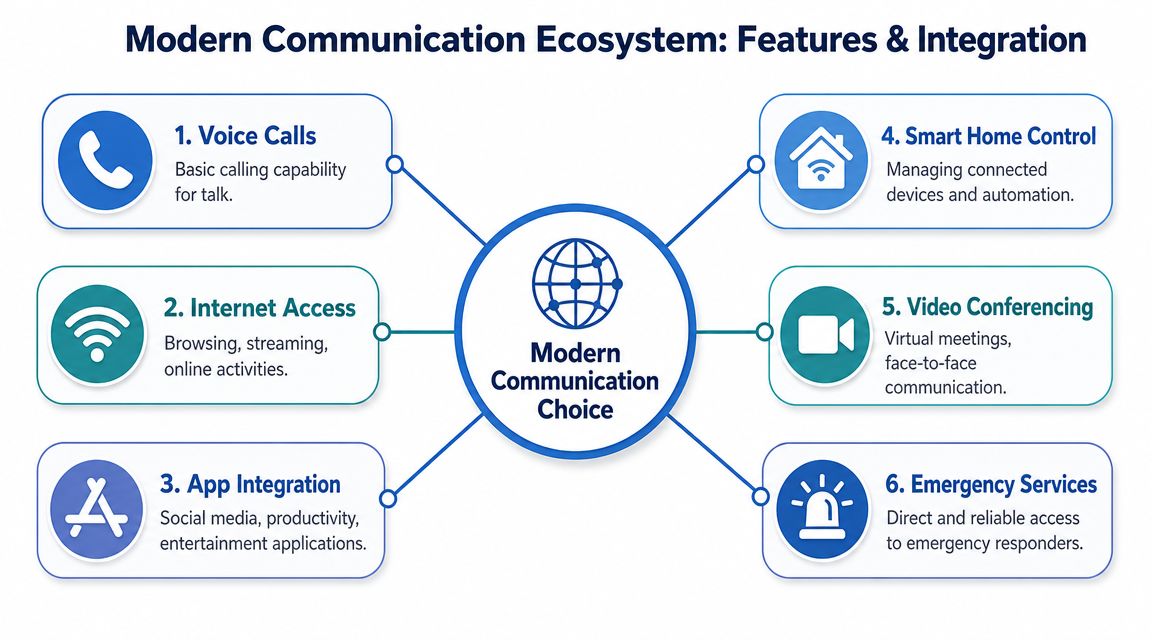
Landlines are generally limited to voice and voicemail, while mobile-enabled and IP-based systems support broader features such as call forwarding, software integrations, analytics, and multi-location use, according to Zoom's overview of VoIP vs landline for business. The same source notes that mobile systems are also more scalable because new users can be added without physical wiring changes.
That changes workflow design in several practical ways:
- Scheduling teams can route calls without physically moving people.
- Professional services firms can keep a consistent client-facing presence while partners work across office, court, and home.
- Clinics can move from call-only intake to a chain that includes secure follow-up and virtual visits.
- Training businesses can connect inbound interest to live sessions or webinars instead of treating calls and events as separate systems.
The hidden value of bundled tools
For growing organizations, standalone landlines usually stop making sense. If you need voice, video, document sharing, and webinars, buying separate tools often creates duplicated admin work and inconsistent user behavior.
A bundled platform can also improve quality control. Staff use one environment, one set of permissions, and one routine for client communication. If your team struggles with audio quality in remote calls, even a basic technical guide like how to stop echo on mic becomes part of smooth operations because modern communications now depend on endpoint setup, not just carrier infrastructure.
The more your work depends on collaboration after the initial call, the less attractive a single-purpose line becomes.
Encryption is no longer optional
For regulated industries, encryption is an added feature only in the sense that it's part of the buying checklist. Operationally, it's a baseline requirement. If patient details, financial matters, legal discussions, or internal strategy are moving through the platform, encryption and access control should be treated as procurement criteria, not marketing extras.
That's especially true if staff use browsers, laptops, and mobile devices. The phone system is no longer isolated. It sits inside your broader security posture.
Recommended Solutions by Use Case
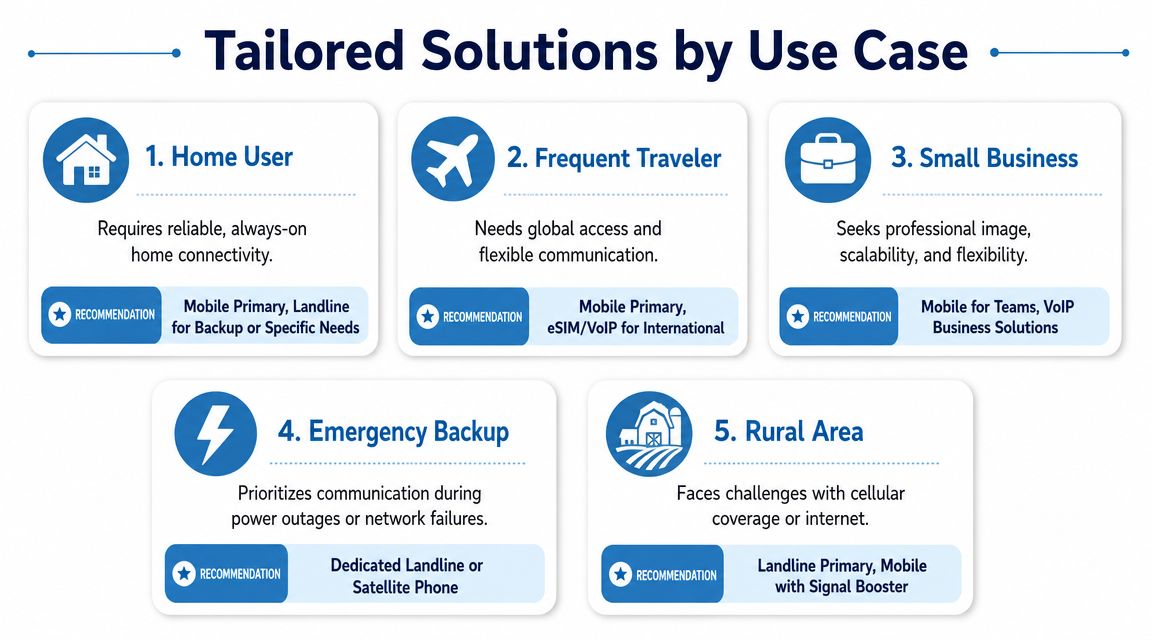
The best setup depends less on the phone itself and more on the work being done around it. Different teams should make different choices.
Telemedicine and healthcare
For telemedicine, a fixed landline alone is too narrow. Clinics need secure scheduling, provider mobility, and a communication path that can support follow-up beyond voice alone.
A practical model is:
- Keep a stable main number for patient trust and front-desk continuity if your workflow benefits from it.
- Use encrypted digital communications for virtual consults and staff coordination.
- Avoid personal mobile sprawl by giving staff a defined business communication environment.
Healthcare owners should be especially careful about informal workarounds. Staff texting from personal numbers or using consumer tools without access controls often creates more risk than the old landline ever did.
Education and coaching
Tutors, coaching centers, and training teams rarely benefit from a plain landline as their primary system. Their real work involves live sessions, reminders, reschedules, recordings, and sometimes webinars or group classes.
What works better is a mobile-first or browser-based setup that supports:
- calls for quick parent or student contact
- video sessions for instruction
- screen sharing and documents for delivery
- simple join links for low-friction attendance
Small business and professional services
Law firms, accountants, consultants, and agencies usually need a professional number, good responsiveness, and continuity across office and remote work.
For these teams, the strongest pattern is often published business number plus mobile or software-based answering behind the scenes. Clients see one stable identity. Staff get flexibility.
If you're evaluating options for a lean team, this guide to best video conferencing for small business is relevant because the phone question often expands into a broader communication stack within a few months.
A small business rarely regrets choosing flexibility. It often regrets choosing a system that assumes everyone stays in one room.
Event marketing and webinars
Landlines are easiest to rule out as a primary system. Event marketers and trainers need registrations, reminders, live delivery, moderation, and post-event follow-up. A landline can support inbound inquiries, but it can't carry the event workflow.
If webinars are part of the business model, the value proposition changes sharply. A platform that includes webinars alongside secure meetings and calling can replace a patchwork of tools. That reduces training time, admin overhead, and the chance that staff use the wrong system for the wrong audience.
Your Decision Checklist and Migration Plan
Most owners don't need a dramatic telecom overhaul. They need a clear buying filter and a low-friction migration path.
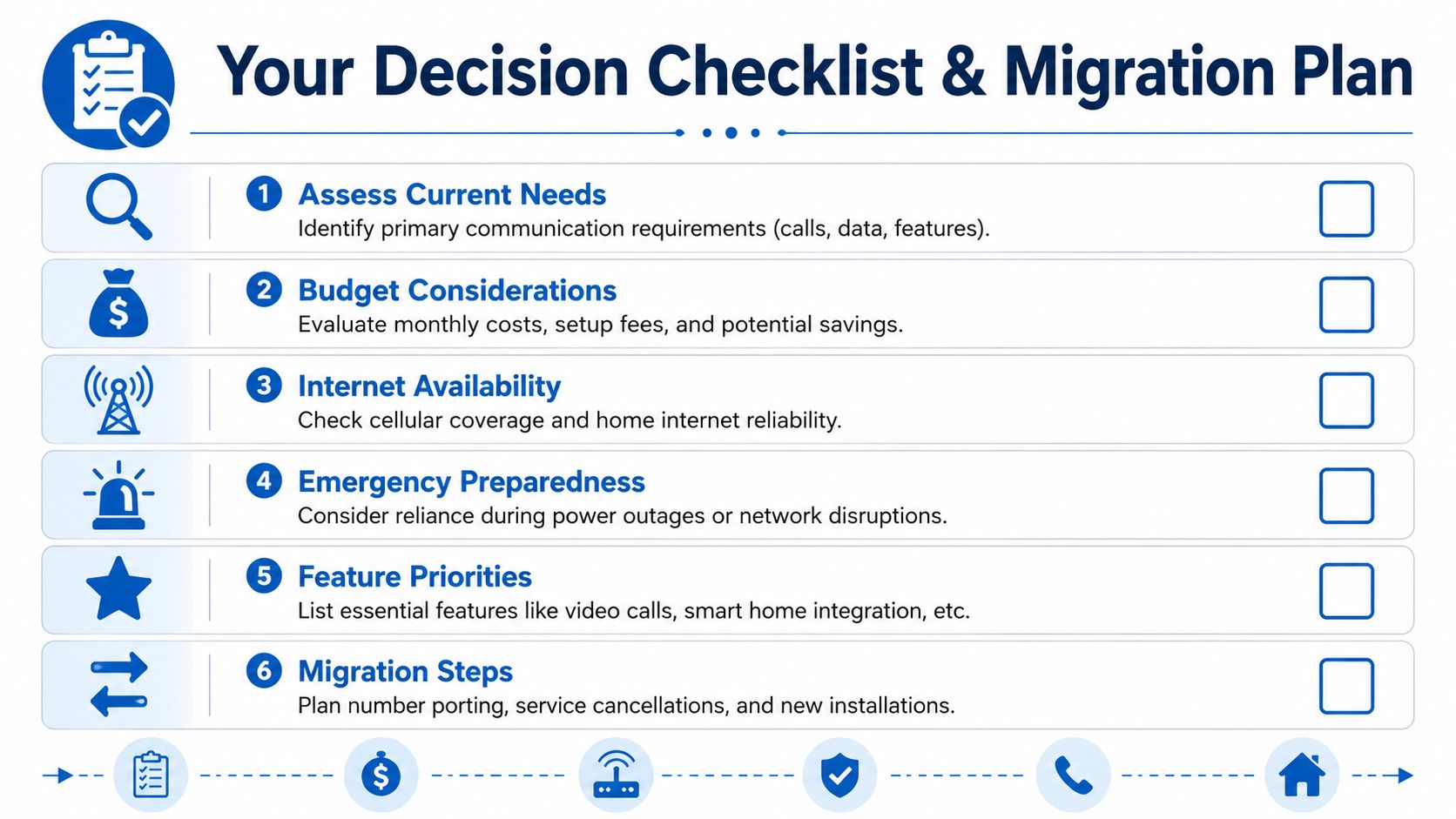
Decision checklist
Use these questions before you sign anything:
Where are calls answered
If your staff answers from one desk all day, a landline still has a case. If calls need to follow people, it doesn't.
What happens after the call
If the next step is scheduling, screen sharing, document exchange, or a video meeting, a broader platform will usually create less friction.
How sensitive is the information
Healthcare, legal, finance, and advisory work should prioritize encryption, access control, and controlled user workflows.
What does failure look like
Don't ask which system never fails. Ask whether your team can continue when signal, power, internet, or location changes disrupt the primary method.
Are you paying for one function or many
A line may look simple. A platform may be the better value if it replaces separate tools for meetings, webinars, and collaboration.
A practical migration path
A smooth move usually follows this sequence:
- Audit the current number setup: List every published number, extension, and department dependency.
- Decide what must stay fixed: Many organizations keep one public-facing number even if staff move to mobile or browser-based answering.
- Map users to roles: Front desk, clinician, partner, coordinator, and support staff often need different permissions and routing.
- Test before full cutover: Run a pilot with internal users first. Verify audio, call routing, join flow, and device behavior.
- Train for real scenarios: Teach transfers, missed-call handling, meeting escalation, and privacy rules.
- Communicate the change externally: Update your website, intake forms, appointment reminders, and email signatures only after the new flow works reliably.
The cleanest migration is usually partial first, not total first. Keep the public number stable while you modernize the workflow behind it.
The right landline vs mobile answer in 2026 is rarely ideological. It's operational. If you need one stable phone at one location, a landline can still make sense. If you need secure communication that travels with your people and connects to modern work, mobile and platform-based systems usually win on value.
If you need a secure, browser-based alternative to patching together separate calling, meeting, and webinar tools, AONMeetings is worth a close look. It's built for healthcare, education, and business teams that need HIPAA-compliant meetings, built-in webinars, unlimited meeting time, and bank-level encryption without enterprise-style pricing or long contracts. Starting at ₹179 per user per month, it's a practical option when you want to lower communication sprawl and keep security and usability in the same platform.
