

In today's world, marketing for a medical practice isn't just a nice-to-have; it's the engine that drives patient growth. It all starts with a smart combination of a high-performing website, dominance in local search results, and building trust through patient education. The entire point is to make sure that when someone in your community looks for a doctor, your practice is the first and best option they see.
Build Your Practice's Digital Foundation
Think of your website as the digital front door to your practice. And we all know how much first impressions matter. Potential patients are now savvy consumers—they research, they compare, and they form an opinion about you based on your online presence long before they ever think about calling. A clunky, slow, or confusing website can send them running to a competitor in seconds. Getting this digital foundation right is the single most important thing you can do for your marketing.
To really get the ball rolling and attract new patients, it helps to understand some powerful small business marketing strategies and adapt them for a local healthcare setting. While they aren't written just for doctors, the core ideas about local visibility and engagement are exactly what you need to build a thriving practice.
Crafting a Patient-Centric Website
A modern medical website has to be professional, easy to navigate, and look great on a smartphone. Seriously. With over 60% of health-related searches now happening on mobile, a site that isn’t mobile-friendly might as well be invisible. But it goes beyond just looking good on a small screen; the entire experience needs to be built around the patient.
Dedicated Service Pages: Don't just list your services on one generic page. If you're a dermatology clinic, you need separate, detailed pages for "Acne Treatment," "Mohs Surgery," and "Cosmetic Fillers." Each page should be optimized for the exact words a patient would use when searching. For example, a page titled "Acne Treatment in Dallas" is far more effective than a generic "Our Services" page.
Authentic Doctor Bios: People choose a doctor, not just a practice. A great bio goes beyond a list of credentials. It needs a professional photo, a summary of specialties, and a personal touch that shows who the doctor is. A practical example would be including a short quote like, "My goal is to partner with every patient to create a personalized care plan that fits their life." This simple step does wonders for building trust before a patient even walks through the door.
Unmistakable Calls-to-Action (CTAs): Every single page should clearly answer the question, "What do I do next?" Make your "Request an Appointment" buttons big and bold. Put your phone number everywhere. Ensure your contact forms are simple and easy to find. Don't make people hunt for information.
My Two Cents: Your website isn't a digital brochure; it's a 24/7 patient acquisition machine. Every menu item, every sentence, and every button should be designed to answer a patient's questions and make booking an appointment completely effortless.
This simple flowchart breaks down how a solid digital foundation directly leads to new patients.
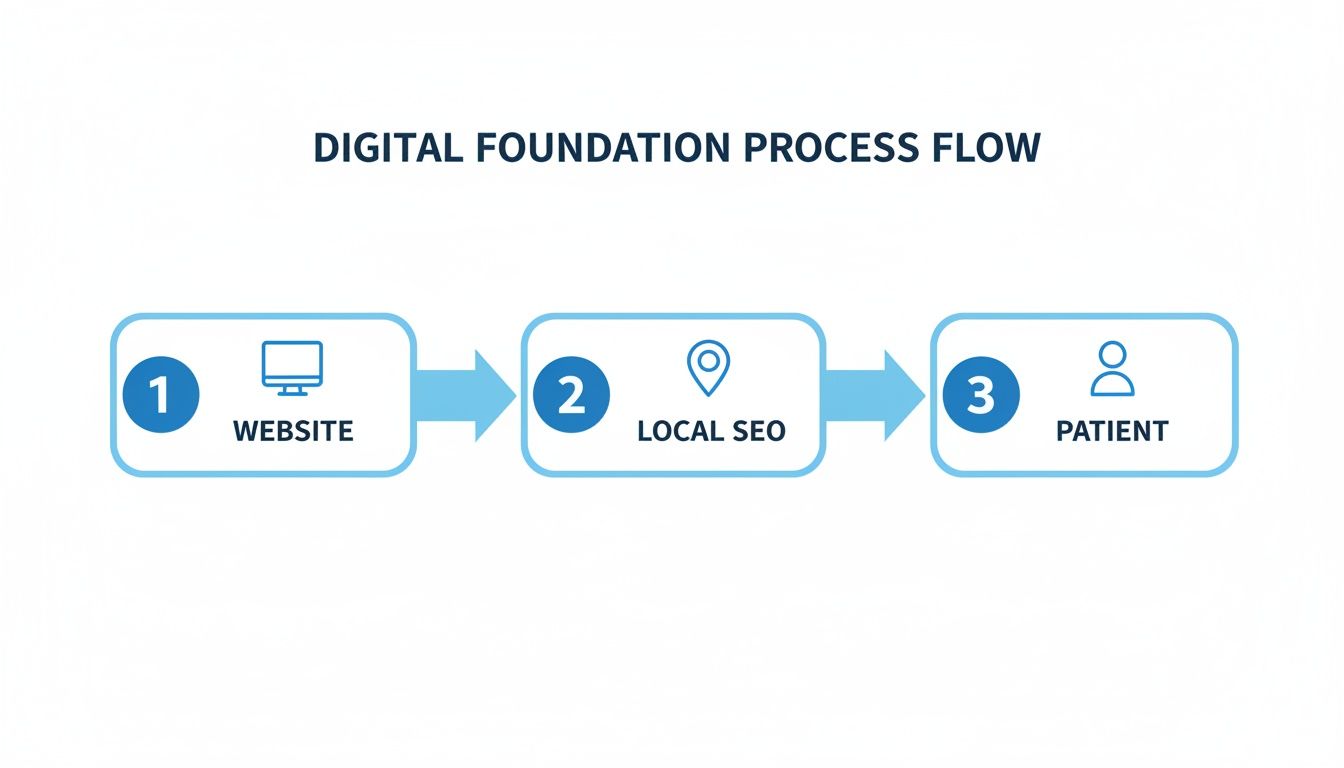
As you can see, a great website is the starting point, but amplifying it with local SEO is what turns that presence into a steady stream of new patient appointments.
The True Cost of Your Website
Putting real money into a professional website can feel like a huge line item on the budget. But trust me, cutting corners here is one of the most expensive mistakes you can make in the long run.
Here’s a realistic breakdown of the options for a small to mid-sized practice:
| Website Development Option | Estimated Cost | The Real Value |
|---|---|---|
| DIY Website Builder | $30 – $100 / month | You get total control at the lowest cost. It's a workable option if you're a brand-new solo practice on a shoestring budget. |
| Freelance Developer | $3,000 – $8,000 | A good middle ground. You get a custom, professional site without the full-agency price tag. Perfect for established practices. |
| Marketing Agency Build | $10,000 – $25,000+ | The all-inclusive approach. This usually covers strategy, SEO, content, and ongoing management. Best for practices serious about aggressive growth. |
While a DIY site seems like a bargain, it will almost certainly fall short on the technical SEO, security, and performance needed to actually rank on Google.
On the other hand, an agency build often includes strategic extras, like setting up HIPAA-compliant features for patient education. For example, they can integrate tools for telehealth or webinars. If you're exploring that, our guide on the best webinar software for small businesses can give you some great ideas to bring to the table.
No matter which route you choose, protecting patient data is non-negotiable. Ensure any partner you work with provides SSL certificates and end-to-end encryption as a standard—not an upsell. This is fundamental for securing patient information submitted through contact forms and demonstrating your commitment to privacy.
Win Patients With Local SEO and Search Ads

So, you’ve got a fantastic new website. That’s a huge first step, but now we have to make sure patients can actually find it the moment they need you. And where do they go? Straight to Google.
It's no secret that the internet is where patients find their doctors now. In fact, a staggering 79% of healthcare providers are already focusing on their websites and SEO to bring in new patients. The results speak for themselves—organic search delivers an incredible 76.9% prospect-to-patient conversion rate. If you're curious, you can dig into more healthcare marketing statistics to see just how dominant search has become.
Having a website is just table stakes. You need a smart, proactive strategy to show up when potential patients are actively looking for care. For that, we turn to two of the most powerful tools in our playbook: Local SEO and targeted search advertising.
Dominate Local Search Results
Think about what a potential patient types into their phone: "pediatrician near me" or "sports medicine doctor in Denver." You need to be the name they see first. That's the entire game of local search engine optimization (SEO).
Your most important asset here is your Google Business Profile (GBP). This isn't optional; it's your digital front door on Google Search and Maps. To get it right, a fully dialed-in profile must include:
- 100% accurate practice name, address, and phone number (NAP).
- The right business categories (e.g., "Orthopedic Surgeon," "Dermatology Clinic").
- High-quality, recent photos of your office, your team, and your equipment.
- A consistent flow of new, positive patient reviews.
From there, you need to build what we call "local citations." These are simply mentions of your practice's NAP on other trusted online directories like Yelp, Healthgrades, and Vitals. Every time Google sees your correct information listed on a reputable site, it builds more trust in your practice, which directly helps your local ranking.
I’ve seen it time and time again: Google rewards practices that provide the most helpful, accurate, and trustworthy information. A complete, active profile with dozens of great reviews will almost always beat a competitor with a bare-bones listing and a handful of old testimonials.
Running Effective Google Ads Campaigns
While SEO is your long-game for building a foundation of free traffic, Google Ads gives you immediate, front-page visibility for your most profitable services. This is where you can be incredibly strategic with your budget. For example, a dermatology clinic I worked with allocated a $5,000 monthly budget specifically to target high-value searches like "Botox near me" and "laser hair removal cost." The return was almost immediate, generating over 40 qualified leads in the first month.
The secret is to structure your campaigns around relevance. Don't just lump all your services into one big ad group. An orthopedic practice, for instance, should have separate, dedicated campaigns for "knee replacement surgery," "sports injury clinic," and "back pain specialist." This lets you write hyper-specific ad copy that speaks directly to a patient's pain point, which in turn skyrockets your click-through rates.
Price and Value Comparison of Marketing Efforts
Investing in search marketing isn't about outspending your competitors; it's about outsmarting them. You need to know where every dollar is going and what you can expect in return.
Here’s a realistic breakdown of how these investments typically look for a medical practice:
| Marketing Channel | Estimated Monthly Cost | Value Proposition & Included Features |
|---|---|---|
| Local SEO Agency | $1,500 – $4,000 | This is your long-term investment in organic visibility. It covers GBP management, citation building, reputation management, and on-site SEO to build foundational authority. |
| Google Ads Campaign | $2,000 – $10,000+ | Delivers immediate traffic from patients actively searching for your services. Costs are flexible, but you get precise targeting and highly measurable patient acquisition ROI. |
| AONMeetings for Webinars | Starts at ₹179 / user / month | Webinars included. A fantastic, low-cost way to generate leads and build authority. Use it for unlimited HIPAA-compliant educational webinars with end-to-end encryption to establish trust and nurture leads. |
See how these pieces fit together? SEO builds your foundation, paid ads capture immediate demand, and tools like AONMeetings help you build relationships through education.
Finally, remember that any patient data you collect from website forms or ad landing pages must be secure. End-to-end encryption isn't just a technical feature—it's a non-negotiable for building patient trust and staying HIPAA compliant. Your website absolutely must have an SSL certificate to protect all data in transit. It’s a simple step that provides peace of mind for both you and your patients.
Turn Your Expertise Into Trust: Content and Patient Education

Getting your practice to show up on Google is just the first step. Once potential patients find your website, what makes them stay? What convinces them you’re the right choice? The answer is content.
In healthcare, content marketing isn’t about flashy sales pitches. It’s about building a foundation of trust. By generously sharing your knowledge, you become more than just another clinic—you become a go-to authority and a trusted community resource. This is how you build a connection long before a patient ever needs to book an appointment.
Answer the Questions They're Already Asking
Think about the questions your front desk and medical assistants answer day in and day out. Those are pure gold for your content strategy. People are searching online for answers and reassurance. Your job is to provide it.
Here’s what this looks like in the real world:
- Orthopedic Clinic: A blog series on "5 Simple Stretches to Ease Morning Back Pain."
- Pediatrician's Office: A quick, two-minute video explaining "When to Worry About a Child's Fever."
- Dermatology Practice: An easy-to-read infographic that breaks down "The Difference Between UVA and UVB Rays."
This kind of content does so much more than drive traffic. It quietly demonstrates your expertise and shows that you care. When someone who read your article on back pain finally decides they need a specialist, your practice will be top of mind.
Your content should answer the questions that keep potential patients up at night. When you give away valuable information freely, you build a level of trust that no advertisement can ever buy.
Of course, as you open up these digital conversations, ensuring patient privacy is non-negotiable. To get a deeper understanding of the tools required, our guide on HIPAA-compliant video conferencing platforms is a great place to start.
Take Your Expertise Live with HIPAA-Compliant Webinars
One of the most powerful ways to connect with your community is through educational webinars. These sessions, whether live or pre-recorded, let you speak to dozens or even hundreds of people at once. It's a fantastic way to make your physicians feel accessible and establish their authority.
A practical example: a cardiologist hosting a live webinar on "Decoding Your Blood Pressure Numbers" with a Q&A at the end. The value for attendees is immense, and for the practice, it's a powerful lead generation tool.
But there’s a catch: you cannot use standard tools like Facebook Live or a basic Zoom account. Patient privacy is paramount, and any discussion involving health topics falls under HIPAA’s strict security rules. You absolutely need a platform that provides end-to-end encryption and is willing to sign a Business Associate Agreement (BAA). This protects all data, from attendee lists to the questions they ask, and shows patients you take their confidentiality seriously.
HIPAA-Compliant Webinar Platform Comparison
Choosing the right platform often feels like a balancing act between features, compliance, and cost. For a private practice, many enterprise-level solutions are simply too expensive or lock you into long, complicated contracts. It's important to look beyond the brand name and compare what you're actually getting for your money.
To help with that, here's a breakdown of some popular options for 2026.
| Feature | AONMeetings (Pro Plan) | Zoom (Healthcare Plan) | Microsoft Teams (Healthcare) |
|---|---|---|---|
| Starting Price | From ₹179/user/month | Starts at $199.90/user/year | Included with Microsoft 365 E3/E5 plans (higher cost) |
| HIPAA Compliance | BAA available, end-to-end encryption | BAA available, end-to-end encryption | BAA available, end-to-end encryption |
| Webinars Included | Yes, included in all paid plans | Add-on feature, costs extra | Included, but requires higher-tier licensing |
| Meeting Time Limits | Unlimited | Varies by plan | Up to 30 hours |
| Contract | No contract, pay monthly | Annual contract required | Annual contract required |
Looking at the options, the value proposition becomes much clearer. For practices just getting started with webinars, a tool like AONMeetings presents a really practical entry point.
The fact that webinar functionality is included right out of the box—even on a plan that starts around ₹179 per month with no annual contract—removes a huge barrier. It allows you to start engaging patients and building that trust without committing to a significant upfront investment or a long-term contract. You get to test what works for your audience while maintaining the highest standards of patient privacy.
Turn Positive Experiences into Practice Growth
What’s the very first thing a potential patient does after getting a referral or seeing your ad? They Google you. Before they ever look at your credentials or the services you offer, they’re looking for social proof.
With 75% of patients now checking online reviews before booking an appointment, what they find on Google, Healthgrades, and Vitals isn't just a part of their decision—it is their decision.
Getting a new patient through the door is a win, but the real work is in keeping them. Sustainable growth comes from turning a one-time visitor into a loyal patient who trusts your practice. This means you need a solid plan for both managing your reputation and keeping patients engaged long-term.
Take Control of Your Online Reputation
Your online reputation isn't something to leave to chance. For any medical practice, learning to master online reputation management is a non-negotiable part of building trust. It's about systematically encouraging positive reviews and, just as critically, handling the negative ones with grace.
One of the easiest ways to get more positive reviews is to simply ask at the right time. The perfect moment is often right after a successful follow-up or a positive appointment. You can even automate this with a quick, personalized email or text message.
Simple Script for Requesting a Review:
"Hi [Patient Name], it was great seeing you today. We really value your feedback and would be grateful if you could share your experience on Google. Your review helps others in our community find the care they need."
Negative reviews are going to happen, but how you respond makes all the difference. A prompt, professional, and HIPAA-compliant reply shows you’re paying attention and can often de-escalate the situation. The key is to acknowledge their concern and then immediately move the conversation offline—never discuss any medical specifics publicly.
HIPAA-Safe Response Template:
"Thank you for taking the time to share your feedback. We are committed to providing an excellent experience for every patient, and we take your concerns very seriously. To discuss this matter privately, please contact our practice manager, [Manager's Name], at [Phone Number]."
The Hidden Cost of a Slow Response
A stellar reputation will generate plenty of new inquiries, but that's only half the battle. This is where many practices drop the ball. Recent data has uncovered a massive lead conversion problem: contacts are 10 times more likely to convert if you respond within the first five minutes.
And yet, the average response time for medical practices is a jaw-dropping 47 hours. When you consider that 90% of patients say they prefer businesses that respond to all reviews and inquiries, you can see how this delay sabotages growth. You can dive deeper into this growing patient acquisition challenge on influxmd.com.
This is exactly why automation has become essential. A simple automated text or email can immediately confirm you've received a new lead's inquiry and let them know when to expect a call. That one touchpoint can make a huge difference in your conversion rates.
Keep Patients Engaged with Smart Automation
It's far more cost-effective to keep your current patients happy and engaged than it is to constantly chase new ones. This is where automated email and SMS workflows really shine, allowing you to maintain a connection without bogging down your front-office staff.
Here are a few practical examples of automated campaigns you can set up right away:
- Appointment Reminders: Drastically cut down on no-shows by sending automated reminders a week out, a day before, and even an hour before the appointment.
- Personalized Health Education: Send out relevant, seasonal content that adds value. A pediatrician might send a guide on "allergy-proofing your home" in the spring, while a dermatologist could share sun safety tips in June.
- Practice Newsletters: A simple monthly newsletter is a great way to share practice updates, introduce a new team member, or promote an educational webinar. It keeps you top-of-mind for future needs.
These small, consistent touchpoints build a real relationship over time. They help turn new visitors into loyal patients who not only come back but also refer their friends and family. If you're hosting events like webinars, you'll want to be sure people show up. For some great pointers, check out our guide on how to increase webinar attendance.
Putting a Price on Growth: Budgeting and Measuring Your Marketing Success
Marketing without data is just guesswork. Pouring money into ads and content without tracking what works is like prescribing a treatment without a diagnosis—you’re hoping for the best, but you have no real idea if it’s actually working. To turn your marketing from an expense into a genuine growth driver, you need a smart budget and a sharp eye on your metrics.
So, how much should you set aside? A good rule of thumb I've seen work for many practices is to budget around 7% of your annual revenue for marketing. If your practice brings in $3 million a year, that works out to $210,000 annually, or about $17,500 a month. Think of this as a direct investment in your practice's long-term health and patient volume.
How to Allocate Your Monthly Marketing Budget
Okay, you have your monthly number. Where does that $17,500 actually go? The key is to build a balanced portfolio that brings in new patients now while also building your brand for the future. You need to capture people who are actively looking for a doctor and also nurture those who are just starting their research.
Here’s a realistic breakdown I often recommend for a practice of this size:
- Google Ads ($5,000): This is your front line for capturing high-intent patients. These are people typing "orthopedic surgeon near me" or "best dermatologist in [Your City]" into Google. You're meeting them at their exact moment of need.
- Social Media ($2,500): This budget covers creating helpful, engaging posts and running targeted ads on platforms like Facebook or Instagram. It’s less about immediate bookings and more about building a community and staying top-of-mind.
- Content & SEO ($3,000): This is your long game. It funds the creation of blog articles, patient guides, and the technical work to get your website ranking high in search results organically. This effort compounds over time.
- Technology & Tools ($500): Don't forget the software that makes it all run. This covers your email platform for patient newsletters and, crucially, a HIPAA-compliant tool like AONMeetings for hosting patient education webinars or virtual consultations.
Choosing Your Tools Wisely
Investing in technology doesn’t mean you have to sign expensive, enterprise-level contracts. It’s about finding the right-sized tool for the job. Take patient webinars, for example. They are a fantastic way to build trust and educate potential patients, but the platform choice matters.
| Platform Comparison | AONMeetings (Pro Plan) | Enterprise Webinar Tool (e.g., Zoom) |
|---|---|---|
| Price | Starts at ₹179/user/month | Often $200+/month (plus add-ons) |
| Webinars Included? | Yes, built into the plan | Usually a costly add-on feature |
| HIPAA Compliance | BAA Available, End-to-End Encryption | BAA Available, End-to-End Encryption |
| Value Proposition | Low-cost entry, no contract, unlimited meeting time, all-in-one value for practices. | Advanced features for large-scale events, but high cost and complexity for simple patient education. |
For a medical practice, the choice is often clear. You can get a secure, encrypted, and easy-to-use tool to engage patients for a fraction of the cost, without getting locked into a system designed for a Fortune 500 company.
Tracking the Metrics That Actually Drive Growth
With your budget in place, it's time to measure. And I don’t mean tracking vanity metrics like social media "likes" or website "impressions." Those feel good, but they don't pay the bills. You need to focus on the Key Performance Indicators (KPIs) that directly map to your practice’s bottom line.
The goal isn't just to be busy with marketing; it's to be profitable. By focusing on CPA and LTV, you can confidently decide where to double down on your spending and what to cut.
This is more important than ever. The healthcare advertising world is getting crowded, with spending in the US expected to climb to $29.2 billion by 2028. In this competitive field, knowing your ROI is everything, especially when some estimates show that 25% of ad clicks can be fraudulent. As you can see in these top healthcare marketing trends, meticulous tracking is your best defense.
Let's walk through a real-world ROI calculation:
- You run a $5,000 Google Ads campaign that brings in 20 new patients. Your Cost Per Acquisition (CPA) is $250.
- You host a $500 webinar series using AONMeetings that generates 5 new patients. Your CPA is $100.
Looking at CPA alone, the webinar seems like the clear winner. But we're not done. What’s the lifetime value (LTV) of these patients? Let's say the average LTV of a patient from Google Ads is $5,000, while a patient who came from the webinar has an LTV of $1,500.
Now, the picture is much richer. The Google Ads campaign delivered a 20x ROI ($100,000 in value from a $5,000 spend), and the webinar produced a 15x ROI ($7,500 in value from a $500 spend). Both are fantastic returns, and it proves that the most powerful marketing strategies use a blend of different channels to achieve their goals.
Common Questions About Marketing a Medical Practice
When I talk with practice owners about marketing, the same few questions always come up. It's completely understandable—you're focused on patient care, and the world of marketing can feel like a whole different language. Let's clear up some of the most common points of confusion.
How Much Should My Practice Spend On Marketing?
This is the big one, isn't it? From my experience, a healthy marketing budget for a medical practice lands somewhere between 7-10% of your annual revenue.
If you're launching a new practice or entering a really competitive urban market, you'll probably want to lean closer to 12% to make a strong initial splash. On the other hand, a well-established clinic with a solid reputation might find that 7% is plenty to maintain its momentum.
Think of it this way: for a practice generating $2 million in annual revenue, the marketing budget would be around $140,000 for the year, or just under $12,000 a month. The key isn't just spending the money; it's meticulously tracking your cost to acquire a new patient to make sure every dollar you spend comes back to you, and then some.
What Is the Most Effective Marketing Strategy?
If you want the single most effective place to put those marketing dollars, it's a powerful combination of Local SEO and a perfectly optimized Google Business Profile. Nothing else comes close for most practices.
Why? Because the modern patient journey almost always starts with a Google search like "cardiologist near me" or "best pediatrician in [Your City]." This isn't about casting a wide net; it's about capturing patients who are actively looking for care right now. The intent is incredibly high.
When you back this up with a constant stream of new, positive online reviews and a professional, easy-to-navigate website, you create a powerful system that consistently brings new patients through your door.
How Do I Market My Practice Without Violating HIPAA?
Patient privacy isn't just a rule; it's the bedrock of patient trust. Every single marketing decision you make has to be viewed through the lens of HIPAA compliance.
This is non-negotiable. Here's what that looks like in practice:
- Get Explicit Consent: Never, ever use patient photos, stories, or testimonials in your marketing without getting their explicit, signed consent on a formal release document. A verbal "okay" is not enough.
- Use Secure Technology: Every piece of software you use that touches patient information—from your email marketing platform to your telehealth service—must be HIPAA-compliant. This means you need a signed Business Associate Agreement (BAA) with the vendor.
- Encrypt Everything: Your website's contact forms need to be secure and protected with end-to-end encryption. The same goes for any patient education webinars or telehealth appointments; they have to run on a platform that guarantees this level of security.
This is where choosing the right tools becomes critical. A platform like AONMeetings is built for this, providing the necessary encryption for virtual consultations and webinars. This isn't just a nice feature—it's a fundamental requirement for protecting your patients and your practice.
A cheap or "free" tool can end up being the most expensive choice you make if it leads to a data breach. It’s simply not worth the risk.
Here’s a quick comparison of why a purpose-built tool is a smarter investment.
| Feature Comparison | AONMeetings (Pro Plan) | Standard Video Tool |
|---|---|---|
| Price | Starts at ₹179/user/month | Can be "free" or low-cost |
| Value Proposition | HIPAA-ready with encryption and BAA, offering peace of mind and demonstrating commitment to patient privacy. | Lacks necessary security; high risk of a breach, potential for severe financial and reputational damage. |
| Webinars Included | Yes, with all paid plans | Often requires expensive add-ons or separate subscriptions. |
Choosing secure, compliant tools from day one isn't a marketing expense; it's an investment in the long-term trust and viability of your practice.
Ready to engage patients with secure, professional video? AONMeetings delivers HIPAA-compliant meetings and webinars with bank-level encryption, all without enterprise contracts or high costs. Discover how you can build trust and grow your practice.
