
When you hear the term end-to-end encryption (or E2EE), what does it really mean? Simply put, it's a way of securing your digital conversations—whether they're messages, files, or video calls—so that only you and the people you're communicating with can ever see or hear them. It’s the gold standard for digital privacy.
The Foundation of Digital Privacy
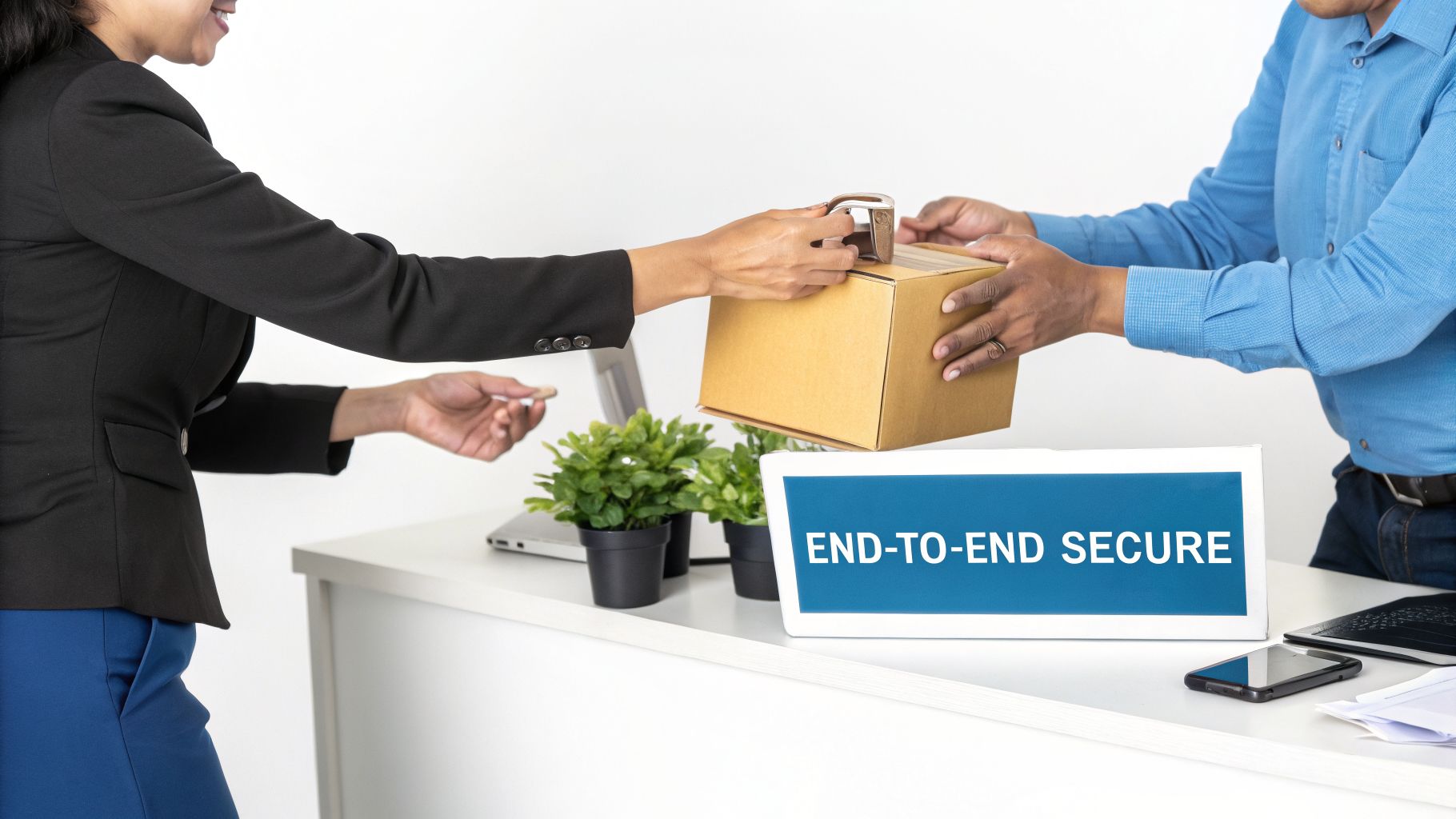
Think of it like sending a package in a high-security lockbox. You put your item inside, snap the lock shut, and send it on its way. The only person who can open that box is the recipient, because they have the only key that works. No one else can get in—not the courier, not the sorting facility, not even a curious neighbor.
This is what makes E2EE so powerful. Your data is protected from "end" to "end." Even the company providing the messaging app or video platform can't decipher your conversations. They see a locked box, just like everyone else.
Why This Level of Security Matters
In practice, this is a game-changer for professionals who handle sensitive information every day. E2EE isn't just a "nice-to-have" feature; it's the bedrock of genuine digital confidentiality.
Here’s where it makes a real-world difference:
- Practical Example (Healthcare): A doctor can hold a telemedicine appointment and freely discuss patient details, knowing the conversation is private and meets HIPAA-compliant standards.
- Practical Example (Legal): A legal team can map out its case strategy over a video call, completely shielded from potential eavesdropping.
- Practical Example (Corporate): A company can unveil its next product roadmap to investors without fear of intellectual property leaks.
In all these cases, E2EE acts as a digital shield, ensuring the conversation stays strictly between the participants.
From a technical perspective, there is no such thing as selective encryption. You cannot weaken it for a few without weakening it for all. Strong encryption makes digital life safer for everyone.
Value and Accessibility in Modern Tools
Not too long ago, this level of security was reserved for those with deep pockets and technical know-how. That's no longer the case. Many modern platforms now include E2EE as a core part of their service, not as a costly upgrade, which has completely changed the game for secure communications.
You can see this clearly when you compare providers. Some legacy platforms still treat E2EE as a premium add-on, burying it in their most expensive enterprise plans. In sharp contrast, a new wave of solutions builds it into every plan, with some offering fully secure services for as little as $2-3 per month per user. This makes top-tier security accessible to small businesses and even solo professionals.
Better yet, many of these platforms bundle E2EE with other essential tools like integrated webinars, giving you a complete, secure, and affordable communications suite. This added value proposition means you get secure internal meetings and can host external marketing events, all within one subscription.
How End-to-End Encryption Actually Works
So, what’s really going on behind the scenes with end-to-end encryption? The entire system is built on a brilliant concept called asymmetric cryptography, sometimes known as public-key cryptography. This process gives every user two separate but mathematically connected digital keys.
Think of it like a personal, high-security mailbox. This mailbox has two key parts:
- A Public Key: This is like the mail slot. You can share it with anyone. People use this slot to drop messages into your mailbox, but the slot only works one way—they can't use it to open the box or see what's inside.
- A Private Key: This is the physical key that unlocks the mailbox. You keep it completely secret and never, ever share it. It's the only thing that can open your mailbox and reveal the messages sent to you.
When someone wants to send you a secure message, they use your public key to lock it shut. Once locked, the message is scrambled into unreadable code. It can travel across the internet, pass through servers, and be seen by anyone along the way, but only one thing can decipher it: your unique private key. Not even the company that runs the service has a copy of that key.
The Digital Handshake in Action
This two-key system is what makes the secure "digital handshake" possible, protecting your conversations from one end to the other. The foundation for this handshake rests on the principles of private key cryptography, which is the bedrock of E2EE's security model.
Here’s a simple breakdown of how it works when you send a message:
- Key Exchange: The moment you start a conversation, your device and the recipient's device quietly exchange public keys in the background. Your app grabs their public key, and their app grabs yours.
- Encryption (Locking): You type a message and hit send. Before it even leaves your device, your app uses the recipient's public key to encrypt it. "Hello, how are you?" instantly becomes a string of nonsensical characters.
- Transmission: The encrypted message travels from your device, through the service provider's servers, and across the network to the recipient. To anyone who might intercept it, it's just digital noise.
- Decryption (Unlocking): Once the message lands on the recipient's device, their app uses their private key to instantly unlock it. The scrambled text immediately turns back into "Hello, how are you?"
This entire sequence happens in the blink of an eye. It’s all powered by robust and well-vetted algorithms like the Signal Protocol, which is widely considered the gold standard and is trusted by many of the most secure messaging and video platforms available today.
The core idea is simple but incredibly effective: data is locked with a public key and can only be unlocked by its matching private key. This guarantees that only the intended recipient can ever read the content.
Why This Method Is the Industry Standard
This all-encompassing security is precisely why end-to-end encryption is the go-to for security professionals. It protects data during its entire journey, from the moment it's sent to the moment it's received, making it far more reliable than other methods.
One statistic really drives this point home: 97% of data protection officers in the U.S. consider E2EE their primary tool for safeguarding data. For comparison, only 3% rely on in-transit encryption alone. This overwhelming preference is because E2EE closes the door on "man-in-the-middle" attacks, where a third party could otherwise intercept and read data as it passes through a central server. If you explore more data privacy statistics, you'll see just how foundational it has become across the industry.
Comparing E2EE With Other Encryption Types
When a communication platform says your data is "encrypted," what does that really mean? It’s a critical question, because not all encryption is created equal. The level of privacy you actually get depends entirely on the type of encryption being used.
Let's cut through the jargon. You'll generally run into three kinds: encryption in transit, encryption at rest, and the one that matters most for privacy, end-to-end encryption (E2EE).
To make sense of it, think about sending a valuable package.
Encryption in Transit (TLS/SSL) is like putting your package in an armored truck. It’s protected on the journey from point A to point B. But here's the catch: when the truck reaches its destination (the service provider's server), the guards unlock it. The contents are now accessible to the provider.
Encryption at Rest is the next step. Your package is now stored in the provider's vault. It's safe from burglars trying to break in from the outside. However, the bank staff—the service provider—still has a master key. They can open that vault and look at your package anytime.
End-to-End Encryption changes the game entirely. This is like putting your package inside a special lockbox before it even goes into the armored truck. Only you have a key, and you’ve sent a copy of that key only to your intended recipient. The armored truck can move it, and the bank can store it, but no one on that journey can open the box.
Only E2EE ensures your data stays completely private from the moment you send it until the moment it's received. The service provider, despite handling the data, is completely blind to its contents.
A Head-to-Head Security Breakdown
So, what does this mean in practice? It all comes down to who holds the keys to your data. This is the single most important factor when you're handling sensitive information, whether you're a therapist conducting a session or a startup discussing a new product. As you weigh the best video conferencing for small business, this distinction should be at the top of your mind.
The flow is actually quite simple, as you can see here.
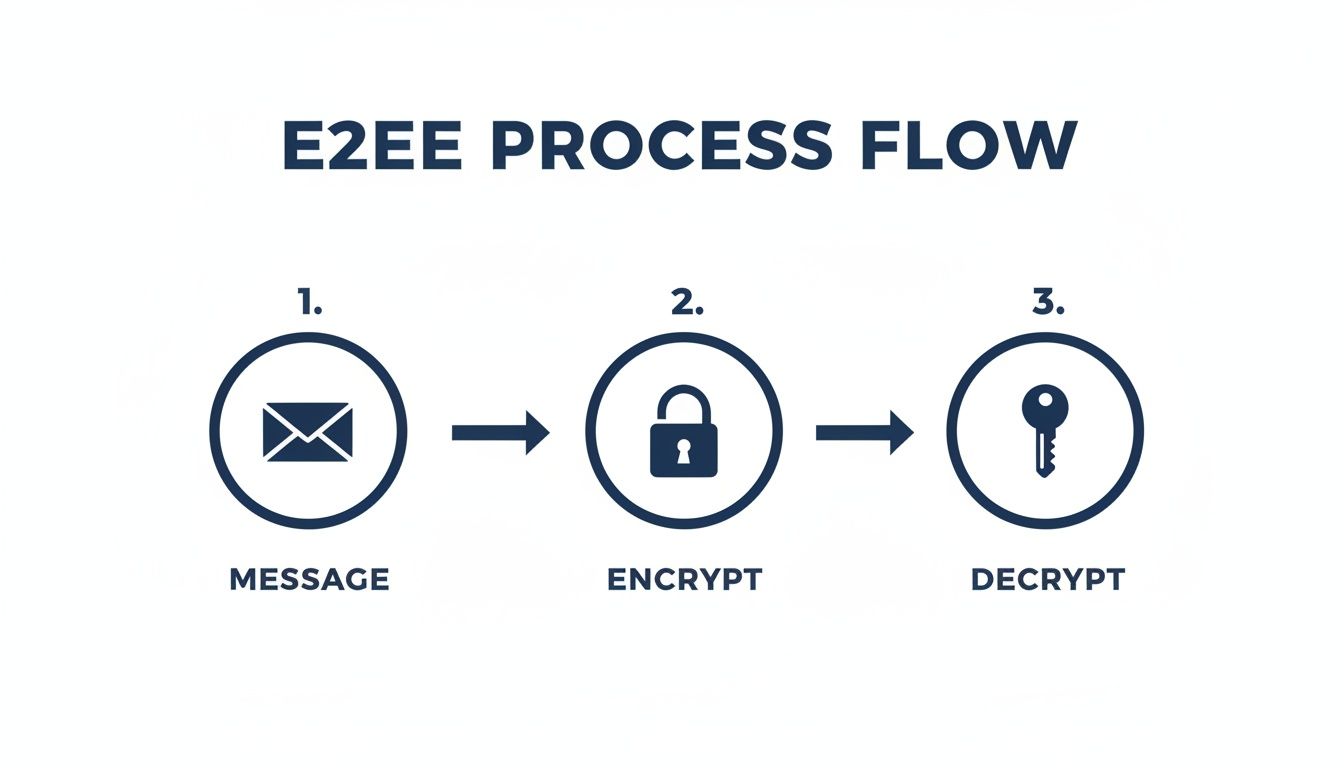
The data is locked on the sender's device and can only be unlocked on the recipient's. There is no middle ground where it becomes vulnerable.
Comparing Encryption Types
Let's put these three methods side-by-side to make the differences crystal clear. This table lays out how each type of encryption handles your data, where it’s vulnerable, and what it looks like in the real world.
| Feature | End-to-End Encryption (E2EE) | Encryption in Transit (TLS/SSL) | Encryption at Rest |
|---|---|---|---|
| Who Holds the Keys? | Only the sender and recipient. | The service provider holds the keys. | The service provider holds the keys. |
| Protection Level | Maximum. Protects data from sender to recipient, including from the provider. | Partial. Protects data only while it's moving across the network. | Partial. Protects data only while it's stored on servers. |
| Key Vulnerability | Endpoint compromise (if a device is hacked). | "Man-in-the-middle" attacks and server-side breaches. | Server-side data breaches and unauthorized provider access. |
| Practical Example | A HIPAA-compliant telemedicine call where the platform cannot access patient data. | Sending an email where the provider can scan the contents for ads. | A file stored in the cloud that the provider can access or be forced to turn over. |
The takeaway here is simple. While encryption in transit and at rest sound secure—and are certainly better than nothing—they leave a massive gap. The service provider can always access your data. For true confidentiality, E2EE is the only standard that closes that gap.
Why This Matters for Your Security Investment
When you're paying for a secure communication tool, you expect genuine security. But many platforms market "encryption" while only providing TLS, leaving your data completely exposed on their servers.
Think about the cost. A basic video conferencing plan might run you $15 per user per month and only offer encryption in transit. At the same time, you can find providers offering true E2EE for just $2-3 per user per month, often with valuable extras like included webinars.
By choosing a platform with real E2EE, you're not just getting far stronger security—you're often getting better value for your money. You're buying peace of mind and protecting your most sensitive conversations, often for a fraction of the cost of less secure alternatives.
Why E2EE Is a Strategic Business Advantage
Thinking about end-to-end encryption as just another security feature misses the point entirely. It's not a defensive move; it's a powerful business strategy. Once you get past the technical details, the real question every organization should be asking is "why bother?" The answer comes down to building a level of trust with your clients and partners that your competitors simply can't match.
When your business handles sensitive information—and whose doesn't?—E2EE becomes the bedrock of your operational integrity. Being able to genuinely guarantee that conversations are private gives you a serious edge. It opens doors to opportunities that are closed to those who can't make the same promise.
From Cost Center to Value Proposition
It wasn't always this way. For a long time, serious encryption was seen as an expensive luxury, something reserved for massive enterprises with deep pockets. That entire model has been turned on its head. E2EE is no longer a pricey add-on; it's a core feature that can deliver a significant return, especially when it comes with tools you're already using.
Just look at the pricing out there. Legacy providers often hide true end-to-end encryption behind their most expensive enterprise plans, charging $20-$30 per user per month and locking you into inflexible annual contracts. This approach treats your security as a premium upsell, not as a fundamental right.
But the new breed of platforms is different. They’re building E2EE right into their standard plans. You can now get platforms that provide always-on, end-to-end encrypted video meetings for as little as $2-3 per user per month. This isn't just about saving money. It makes top-tier security accessible to everyone, from a solo therapist to a fast-growing tech startup.
The real game-changer is when E2EE is seamlessly integrated. When a platform includes secure meetings and adds features like webinar functionality at no extra cost, you get a single solution that can protect both a top-secret internal strategy session and a large-scale marketing event.
Protecting Your Most Valuable Assets
In the real world, E2EE acts as a digital vault for your most critical conversations and data. It's the difference between discussing a confidential deal in a soundproof room and shouting it across a crowded coffee shop.
Think about these everyday scenarios:
- Practical Example (Healthcare): For any therapist or doctor, E2EE is the foundation of a HIPAA-compliant practice. It guarantees that patient consultations and medical records stay completely private, protecting patients and shielding the clinic from potentially ruinous data breach fines.
- Practical Example (Product Development): Imagine a startup giving a product demo to an investor, or an agency presenting a new campaign to a major client. With E2EE, they have peace of mind knowing their source code, strategic plans, and proprietary designs are shielded from prying eyes and corporate espionage.
- Practical Example (Finance): Lawyers can go over sensitive case details, and financial advisors can review personal wealth strategies, all with the full assurance that their conversations are privileged and can't be intercepted.
The demand for this level of security is exploding. The global market for encrypted communication, valued at USD 7.45 billion in 2026, is on track to hit USD 19.97 billion by 2032. This surge is fueled by regulations like GDPR and HIPAA and a relentless increase in cyberattacks. A stark reminder of the stakes was a major 2024 data breach where a simple server misconfiguration exposed 106 million U.S. records. That’s a catastrophe that properly implemented E2EE would have made irrelevant. You can see how market trends are directly tied to these high-profile security failures.
By making E2EE your default standard, you’re not just buying a feature. You're investing in business continuity, compliance, and your brand's reputation. It sends a clear signal to your clients and partners: you take their privacy as seriously as you take your own. In today’s world, that kind of trust is priceless.
Putting E2EE to Work in Your Daily Operations

It’s one thing to get the technical explanation of end-to-end encryption, but it really clicks when you see where it shows up in your day-to-day life. You're probably already using E2EE without even thinking about it. It’s the invisible shield working behind the scenes in many popular messaging apps, keeping your private chats and family photos genuinely private.
But where E2EE truly flexes its muscles is in the professional world, where a casual conversation can involve sensitive company data and the stakes are infinitely higher.
Securing Professional Collaboration
In a business context, E2EE is more than a nice-to-have feature; it’s the foundation of trust. It essentially creates a private, digital conference room where your team can discuss strategy, negotiate deals, and collaborate on sensitive projects without any risk of being overheard.
A truly secure platform wraps this protection around every part of the meeting experience. It’s not just about the audio and video.
- Practical Example (Screen Sharing): When you need to present a confidential document or demo a piece of proprietary software, E2EE ensures only the people in the meeting can see your screen. Feel free to reference our guide on how to share your screen securely to get the most out of this.
- Practical Example (File Transfers): Dropping a contract or financial report into the meeting chat? That file is encrypted on your device and can only be decrypted by the intended recipients. No one can intercept it in the middle.
- Practical Example (Recordings): If you record a meeting to review later, the recording file itself is encrypted. This is crucial for things like compliance training or keeping a record of major decisions without leaving that content exposed.
Critical Use Cases Across Industries
The real-world impact of E2EE becomes crystal clear when you look at industries where confidentiality is everything. It’s the key that allows professionals to do their jobs securely and meet strict regulatory demands.
Take telemedicine, for instance. For a therapist holding a private session or a doctor discussing a patient's diagnosis, E2EE is the technology that enables HIPAA-compliant video conferencing. It’s what guarantees patient-doctor confidentiality in a virtual setting.
In the legal world, the need is just as pressing. E2EE allows lawyers to maintain attorney-client privilege during virtual consultations and strategy sessions. Without that guarantee of privacy, the entire legal process could be compromised.
Likewise, corporate boards rely on E2EE to discuss quarterly earnings, potential mergers, and other information that could move markets. It’s what makes modern corporate governance and high-stakes decision-making possible in a remote world.
The Financial Case for E2EE
Beyond the obvious security benefits, adopting E2EE is simply a smart financial move. We all know a data breach can be catastrophic, yet many business leaders still think of robust encryption as a pricey, enterprise-level luxury. That’s an outdated idea.
Today, many forward-thinking platforms have made E2EE a standard, built-in feature, not a costly add-on. While some legacy providers might still charge $20 or more per user for plans that include it, you can now find powerful solutions that offer it for as little as $2-3 per month.
What's more, these affordable platforms often pack in a lot more value. It’s common to see E2EE bundled with other essential tools like webinar functionality, giving you a secure, all-in-one communication suite without the hefty price tag.
The market is taking notice. The end-to-end email encryption market, valued at USD 4.9 billion in 2026, is projected to explode to USD 54.4 billion by 2034. This surge is largely driven by the need to comply with regulations like HIPAA and CCPA, particularly in North America, which holds 37.6% of the market share. You can discover more insights about these market trends and see for yourself why securing communications has become an absolute priority.
How to Choose a Truly Secure E2EE Provider
Every vendor out there seems to slap the word "encrypted" on their marketing materials these days. But with so much noise, how can you tell which platforms offer genuine, Fort Knox-level security and which are just selling you a false sense of safety?
It all comes down to asking the right questions. Once you know what to look for, you can quickly separate the truly secure providers from the ones with clever marketing. Let's walk through what you need to scrutinize.
Digging Into the Details: What to Ask a Vendor
First, find out if their end-to-end encryption is on by default for every call and message. A truly secure provider makes E2EE the standard, not a premium add-on or an optional setting you have to hunt for. If it’s a toggle buried in a settings menu, that’s a huge red flag—it means many conversations are probably happening in the clear.
Next comes the most critical question of all: Who holds the encryption keys? If the provider manages the keys on their servers, they can access your data. It’s that simple. True E2EE means only the participants in the conversation—and absolutely no one else—hold the keys.
The gold standard is a provider who is transparent about their security architecture and openly states that they cannot access user data because they do not hold the encryption keys. Vague promises are worthless; clear documentation is essential.
Look for a public security whitepaper. A confident, secure company will be proud to show you how its system works. If they get cagey or just point you to a vague marketing page, that tells you everything you need to know.
Don't Just Buy Security, Buy Value
When you're comparing options, look at the whole picture. A platform might tick the E2EE box, but what else are you getting for your money?
- Example 1: The Basic E2EE Plan. One provider offers E2EE for video calls, but it costs $15/user/month. The plan is secure, but it's barebones—no webinar features, limited recording, and other essential tools cost extra.
- Example 2: The Integrated Value Plan. Another provider includes E2EE as a standard feature on its $3/user/month plan. On top of that, you get unlimited webinar hosting for up to 100 people, screen sharing, and recording, all fully encrypted.
Looking at it this way, the second option delivers far more practical value. It proves that top-tier security doesn't have to break the bank.
Verifying Claims and Finding a True Partner
Don't just take a vendor's word for it—verify their claims. The privacy policy and any compliance documents are your best tools. Read them carefully and look for explicit language confirming E2EE is applied to all data types, including video, chat, and file transfers.
For certain industries, this is non-negotiable. If you're in healthcare, for example, you have to understand the specific requirements for HIPAA-compliant video conferencing platforms.
Finally, look for a provider that acts more like a partner than a vendor. Do they offer helpful resources, like webinars on security best practices, to help your team use the platform safely? The best providers combine a rock-solid technical foundation, transparent policies, and fair pricing with a genuine commitment to helping you stay secure.
Common Questions About End-to-End Encryption
Even with its clear security benefits, a few common questions and myths about end-to-end encryption always seem to pop up. Let's walk through them to clear up any confusion and give you a practical understanding of how E2EE really works.
Is E2EE Completely Unbreakable?
The short answer is no, but the reason why might surprise you. The encryption algorithms themselves, when implemented correctly, are virtually unbreakable with today's computing power. The math is solid.
The real vulnerability isn't the encryption; it's the endpoints. Think of it like a reinforced steel tunnel. The tunnel itself is impenetrable, but if someone can get to the entrance or exit, they can see what goes in and out. If a hacker compromises your device (or your recipient's) with malware, they can intercept messages before they're encrypted or after they're decrypted.
That’s why true security is about more than just encryption. It requires good habits, like using strong passwords and watching out for phishing scams. When you’re looking at a provider, always check their comprehensive privacy policy to see how they handle your data and confirm they are truly committed to E2EE principles.
Can E2EE Work for Large Webinars?
Absolutely. There's a lingering myth that E2EE can't scale for large groups or webinars. While this might have been a hurdle for older systems, modern protocols like Messaging Layer Security (MLS) were specifically designed to handle large groups efficiently.
E2EE for large groups is not only possible but also crucial. It protects the integrity of the communication for everyone involved, from a small team meeting to a large-scale webinar.
Many platforms now offer this as a standard feature, not some expensive add-on. You can find services that bundle fully encrypted meetings with webinar functionality for hundreds of people, often for as little as $2-3 per user per month. Secure, large-scale communication is more accessible than ever.
Does E2EE Slow Down Performance?
Another common worry is that all this heavy-duty encryption will slow down your connection, causing laggy video and choppy audio. In reality, the impact of a modern E2EE system on performance is negligible.
The encryption and decryption happen instantly and locally on your device, handled by highly optimized software. You're getting ironclad security without giving up the speed and call quality you need. A well-designed E2EE video call feels exactly the same as a non-encrypted one—the only difference is your conversation is kept completely private.
Ready to experience the security and value of true end-to-end encryption? AONMeetings delivers HIPAA-compliant meetings with built-in webinar functionality, all without contracts or hidden fees. Start protecting your conversations today.
